 The other night I had dinner with a former student/player of mine. We ran into each other a few months back. Our common love of books and podcasts started the conversation. He’s freshly out of college and we’ve been talking about life and career lately. This dinner was a eye opening conversation for me and I’m hoping that this post will help someone who may be in the same spot as my friend.
The phrase that he uttered the most was “I don’t know.” In some ways this could be viewed as a positive. Moving from the teen years where young people tend to think (or project) that they know everything, “I don’t know” could be a sign of positive motion. In this case (and possibly for this generation) there was a definite sense that his need to know was a bit of a surprise. His GPS had gotten him to the restaurant. He mirrored my choice in beer and our conversation followed that theme of uncertainty. While I know that this is not completely his fault, he needs to deal with the consequences. The finger of blame will do nothing to give him direction or satisfy the remainder of his life. So how does one find the answers for the test that’s not coming?
The first step is recognizing that the answers are your answers, not right or wrong answers. While the majority of a young person’s life may be spent in a very regimented existence today, the “real world” is becoming less definite each year. The internet has changed the rules of almost every facet of our lives. Industries that did not exist ten years ago are major components of our everyday life. The economy, geopolitics, the job-market and many other areas of life are variable at best and regularly volatile. While this amount of change may be disconcerting to some, the way to avoid being swept away in a tumultuous seas is to have an anchor. In a world that is always changing, it is important to find consistency in something that is under your control: YOU.
Perhaps the hand that you were dealt is not what you wanted, you still have to play it. For most of us, mom and dad can’t be relied upon forever. At some point we all must take responsibility. Break that word down into “response” and “ability”. Having the ability to respond to the good, the bad and the ugly of your life rests completely with you. Is your response going to be “I don’t like this”, “I hate this”, “I’m not ready for this” or “I can work with this”? Regardless of your circumstances, the only one that makes any sense is to work with the ingredients that you have. Stop comparing your life to some celebrity’s airbrushed picture perfect life or some other source that detracts from your pure power. No matter what comparison is a waste of time. No one has exactly your set of unique ingredients, so the only person that you’re competing with is yourself. There comes a time in each of our lives that we realize that this life belongs to only us. It is not your teachers’, parents’, professors’ or bosses’ life. If you choose to give them control, it is still your choice. So no matter what the question, the answer is yours to choose.
The second key is realizing that time is on your side and patience truly is a virtue. If you’re in your twenties or teens, you’ve got the time to figure things out. Just because you don’t have the answer right now, doesn’t mean that you won’t eventually. Amazon does not do “same day delivery” on the perfect life. Even the most incredible stories of overnight success usually have a less known story of hardship and patience. Unfortunately in a 140 character world, it’s easy to have expectations that surpass what the world actually consistently delivers. The only thing that you can get RIGHT NOW is the opportunity to plant seeds that you can reap in a year, five years, ten years or more. Climbing the mountain is not an instantaneous process and even if you could teleport there, you’d miss all of the good stuff that comes with the climb.
So take these two points out into the world and use them. Anchor yourself with an unshakable belief that you can figure out your life on your terms. Then be patient with your pursuits because nothing worth having comes without effort. With those two concepts in mind, I’m sure that you’ll do well on this art project called life. Enjoy it! It’s yours!
Pete
 The future is out there and you’re going to arrive at it whether you’re ready or not. The problem is that the future is unclear like on a really foggy morning. The haze itself is nothing to fear. It will dissipate as you get closer. It’s possible to move at full speed in territory that is known and clear. On new and uncertain paths, it’s important to manage your speed with your field of vision. Going too fast on a new road could end in a crash. The thing is that most people are not afraid of the ditch, pothole or even the wall. They’re afraid of the uncertainty that the fog brings.
 The act of being human is not always an easy one. Despite all of our advantages, we still run into plenty of obstacles and potholes. There is an odd feeling that I have inside that I am more than one person. I’ve written before about my fascination with
  In this country and around the world Champions are lauded for their accomplishments. Usually the scene of victory is filled with a trophy to be kissed, confetti falling, champagne popping and players/fans rejoicing. The reason that this scene is so easy to recreate in one’s mind is that it is pervasive throughout sport. Depending on the particular sport, one could be even more specific about the scene. Regardless of which championship is won there is an invisible specter that is ever-present but has seemingly been forgotten by many who are watching. The fruits of the labor are on full display but the labor often gets overlooked. In a world where instant gratification is becoming more of the norm will we be seduced by the empty triumph of getting the small reward now or choose the labor that creates real results? The answer is that both will happen.
 If you go to a fine restaurant and order a steak, you will probably enjoy a fine meal and receive no side-ward glances from anyone. The location and timing are everything. On some level you must realize that months earlier, that steak was part of cow. If you got dressed up, went out into the field and bit the cow’s ass, you’d definitely get a reaction especially from the cow. There’s a place and time for almost everything. Getting that combination right is the difference between being cheered and ridiculed. To a certain extent, Galileo was considered a “cow-biter”. The things that he was saying and doing were so far ahead of their time that no one understood them. He was even excommunicated from the church for his beliefs. People were not ready to hear what he was saying because they were too invested in their worldview.
 To a certain extent, I feel like I’m in therapy or at an AA meeting about to admit one of my biggest weaknesses but here it goes: I like a lot of Keanu Reeves’ movies. It really shouldn’t be that embarrassing because the man’s movies have made millions (maybe billions) over the years. Unfortunately he gets a bad rap because he’s pretty goofy and doesn’t have a lot of range. The interesting thing is that for the most part, this anti-Keanu sentiment comes from people who have never acted before and have paid to see his movies. So is it really that he is THAT bad? Or do people simply have a need to pick apart a mediocre swan because it’s easier than looking in the water to see an ugly duckling reflected back?
 Each of us has a potential amount of fire power in a given year. If you think of your energy to finish projects as gunpowder, some of us have a barrel full and others could barely fill one of those Chinese novelty snap pellets. While knowing how much powder you have is helpful, it is also important to divvy it up intelligently. Even the barrel-full may not be sufficient if divided a thousand times and put into the wrong weapons. By contrast, an intelligently used pinch could be life-changing. So how much firepower do you really have and where are you going to use it?
 At the end of this year will you be basking in the glory of your successful hunt? Or will you be left standing with your Red Ryder Carbine in denial that you’re full of hot (but compressed) air? That’s completely up to you and it starts right now. Pick out your targets, if you haven’t already. Write them down and decide how you will take them down. Although truly ‘How’ is very rarely the problem. It is usually getting the focus and commitment to the target that people fail to do. So write them down now!
 Once you have your targets, then you can plan out how to systematically deal with each one. It’s a simple enough process once you commit to it. What you need to do is “fall back on superior firepower and superior intelligence. And that’s all she wrote!”
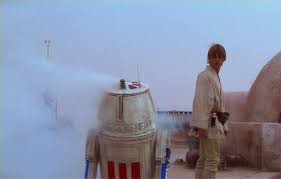 It’s a throwaway line from Star Wars: A New Hope. The purists will point out that the actual line is “This R2 Unit has a bad motivator!” but either way it is enough to stop the red droid in his tracks. At that point, it’s back in the sand crawler with the Jawas. There is something all too familiar about this situation. At times motivation seems like an illusive force that some people have the power to wield while others struggle to find it. There is nothing supernatural about it. The reason to do or not do something (don’t get me started on trying) is a mixture of chemicals that are released in our brains and the story that we tell ourselves. So if you’re not doing something that you want to (or know that you should), it’s because you’ve got a bad motivator.
 For the past six months or so, I’ve been learning Polish using a program called Duolingo. It is a completely free online language learning tool. I started using it to prove the point to my students that you can learn a foreign language by using such a tool. When summer hit, I took a Polish hiatus but now I’m back on the train. The funny thing is that I’m not sure that I’ll ever get to Poland. It is the homeland of my ancestors and I love to travel but it is not a huge priority. So then why bother to learn the language? There is no foreseeable return on my daily investment of time and energy into this language.
