In 1925 President Calvin Coolidge famously said that “The business of America is business.” Almost a full century later, those words are still quoted often enough for it to be recognized. Since the proliferation of the internet to most households, the pace of information exchange and communication has continued to increase almost exponentially. The problem is that with so much information flying around, very few people are taking the time to communicate or do anything to the best of their ability. It seems that with technology as our guide “The business of America is BUSYness.” There is no soap box under my feet. I am not chastising, judging or pointing a ridiculing finger. This post is as much for me as it is for anyone who reads it.
 Distraction is a way of life in the country at the moment. Not only is completing tasks without getting distracted difficult but the fear of missing out (FOMO) seems to be an almost pervasive issue. People have divided their focus between too many activities and are simultaneously getting distracted from them. It’s a recipe for disaster no matter how you slice it. No one can be everywhere for everyone every time. Distraction always comes with a price tag and it is not you who is profiting. The losses are felt by you, your family, your friends, your colleagues and classmates. The people who are actually in your life are the ones who are missing out on a key component of their experience and that is you. All of you, not the partial you that has a technological device in hand “JUST IN CASE!” The cyborg version of you that cannot let go of the phone, tablet or computer has a distinct weakness, it is never fully present.
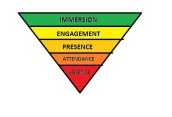
So many of our systems are built largely upon attendance but that model is at best flawed and at worst catastrophically broken. Absence, attendance, presence, engagement and immersion are very different levels of an inverted pyramid of human involvement. While attendance is a nice start, it is just barely above absence and meets only minimum requirements. Showing up is just not enough. To really take full advantage of this life that you have been gifted, you must strategically move up the pyramid with the things that you have decided really matter. And there lies the problem we must DECIDE. Decide comes from the Latin meaning to cut off. We must cut off the things that don’t matter in order to preserve the things that do. Our focus needs to be cut down to that which we value most.
The only person who can win this focus battle for you is you. Anyone can suggest, plead or punish you to do it but you do not have to comply until you choose. In the end there are so many companies and individuals who want your focus. It is your job to divvy it out as you see fit or scatter it without a care. Where you put your focus determines your life. If you decide to immerse yourself in Facebook, that is your choice and far be it from me to judge. As long as it is a decision and not a resignation to the world of distraction. Choose what you want for yourself before others choose for you.
Pete
Do what you can, with what you have, where you are. -Theodore Roosevelt

 Directing a youth sport organization has the opportunity to be a rewarding experience in which your thoughts, processes, and philosophies are introduced to enrich the lives of the athletes, families, coaches, and all other followers connected to the group. The privilege granted to be a resource to many while controlling the final decision on significant organizational matters is a desirable leadership position.
 Each of us has a potential amount of fire power in a given year. If you think of your energy to finish projects as gunpowder, some of us have a barrel full and others could barely fill one of those Chinese novelty snap pellets. While knowing how much powder you have is helpful, it is also important to divvy it up intelligently. Even the barrel-full may not be sufficient if divided a thousand times and put into the wrong weapons. By contrast, an intelligently used pinch could be life-changing. So how much firepower do you really have and where are you going to use it?
 At the end of this year will you be basking in the glory of your successful hunt? Or will you be left standing with your Red Ryder Carbine in denial that you’re full of hot (but compressed) air? That’s completely up to you and it starts right now. Pick out your targets, if you haven’t already. Write them down and decide how you will take them down. Although truly ‘How’ is very rarely the problem. It is usually getting the focus and commitment to the target that people fail to do. So write them down now!
 Once you have your targets, then you can plan out how to systematically deal with each one. It’s a simple enough process once you commit to it. What you need to do is “fall back on superior firepower and superior intelligence. And that’s all she wrote!”
 It’s a throwaway line from Star Wars: A New Hope. The purists will point out that the actual line is “This R2 Unit has a bad motivator!” but either way it is enough to stop the red droid in his tracks. At that point, it’s back in the sand crawler with the Jawas. There is something all too familiar about this situation. At times motivation seems like an illusive force that some people have the power to wield while others struggle to find it. There is nothing supernatural about it. The reason to do or not do something (don’t get me started on trying) is a mixture of chemicals that are released in our brains and the story that we tell ourselves. So if you’re not doing something that you want to (or know that you should), it’s because you’ve got a bad motivator.
 It’s January 9th and the gyms are getting less crowded by the day. The “Gymcensus” is almost over. With the holiday season having just ended, the story behind Christmas should be in mind but I’ll recap just in case. The story of Christmas starts with Joseph bringing Mary, his betrothed, to Bethlehem to be counted for the census. Due to the large influx of people, Joseph and a very pregnant Mary were forced to stay in a stable because there was no room at the inn. In that stable Jesus was born. Then he and his family had to flee in order escape the wrath of King Herod who intended to kill the child. Now we have created the modern equivalent.
 At one point in my educational career, transparencies were the height of technology. By today’s standards they are obsolete but at the time they were extremely helpful. The ability to manipulate and project for a group to see was used daily. My most vivid memories of them were from history class. A territory could be shown with a variety of borders and other influencers. Depending on the transparency that was placed onto the territory, a force like the Roman Empire could be all encompassing or completely inconsequential. The territory was always the same but the translucent lines of borders and boundaries changed. Even though the transparency projectors have all but disappeared, the influence of invisible and imaginary lines has not.
 Physically, mentally and emotionally; what do you believe about yourself, people and the world? Write it down in your notebook, iPhone, laptop or anything else that works for you. Then pick through it to see what you’re keeping, tweaking or tossing. It’s up to you to clean up whatever mess you might have. If you’re honest in your assessment, you’ll be able to see through the person that you need to read better than anyone else: yourself.
 For the past six months or so, I’ve been learning Polish using a program called Duolingo. It is a completely free online language learning tool. I started using it to prove the point to my students that you can learn a foreign language by using such a tool. When summer hit, I took a Polish hiatus but now I’m back on the train. The funny thing is that I’m not sure that I’ll ever get to Poland. It is the homeland of my ancestors and I love to travel but it is not a huge priority. So then why bother to learn the language? There is no foreseeable return on my daily investment of time and energy into this language.