 Most of the time soccer is a noun but today I’m going to use it as a verb. Of course when you are creating a new word, it’s important to define it. Here is my explanation of the term.
The action of “soccering” is not the act of playing soccer. We already know how to say and do that. And NO! It doesn’t mean acting like you’re injured when no one did anything to you. The action of soccering is the real life application of the virtues that are possessed within the game. In soccer, players must make real time decisions about what to do, based on the stimuli that they take in from both teammates and opponents in order to achieve the outcomes of simultaneously reaching a goal while defending their own. The soccer paradigm puts the impetus of decision onto eleven individuals acting as a collective rather than following the pre-scripted orders of an overseer. Although positioning and style of play may be directed, principles and judgment are the main directors of decisions.
America needs to soccer! It needs to take back the very impetus that this country was founded upon. Regular people doing things as a collective that move us all forward and protect us against failing. We need regular citizens who want to be self-determining within the existing system and help to influence that system. At the moment we seem to be overwhelmingly passive and extremely willing to look for someone else to be accountable rather than looking to be responsible ourselves.
We can soccer by trying to improve our lives and the lives of those around us. We can soccer by changing our perspective from a “they” to “we” mentality. We can soccer by doing the right thing even if we know that no one else will notice but us. We can soccer by deciding to take a chance on something that might not work, rather than doing it “the way we’ve always done it.” There are so many ways to soccer but the thing about soccering is that it has to start with you. You can’t tell someone else to soccer. You can only show them how by doing it first and being an example.
Below is a long description of the historical paradigms where this thought came from. If you are inspired to do something right now, then don’t read the bottom, act now, read later.
Why do I believe that America needs to soccer? The historical successes of the United States have in large part been attributed to a football paradigm. Land acquisition and forward progress are the hallmarks of the All-American sport. In the past, both politically and economically, we have pushed forward in the name of progress and it has served us well. Manifest Destiny is the perfect example. Presidents and other decision-makers laid out a playbook for the American people to score a touchdown on the Pacific coast. Americans led the charge across the continent through wars and promised economic success, the way football players might listen to a play called from the sidelines. The Space Race, the Arms Race, the Cold War and Industrial Revolution were all perfectly suited to the football paradigm. So why change?
The reason for change is that the football paradigm is fundamentally flawed in a few different areas. The idea of neverending progress is unrealistic. At some point stock prices level off, profits decline and progress slows and stops. In a paradigm that preaches forward motion as the truest indicator of success, it is not surprising that we have: insider trading, big CEO bonuses for bailed out companies and strategic layoffs to protect profits. Individuals, companies and the government have all pushed toward their given marker of success whether it be money, land, power or prestige. These success markers are not inherently evil or negative but their acquisition without thought to the human equation has created an imbalance in our perspective on success.
There are also the separations in the football paradigm. The coach is the one who calls the plays. The offense scores the points and the defense stops the other team. Although all are members of the same team, it is easy to point the finger at another individual or group when things go wrong. In the Industrial Revolution this system was completely acceptable. Henry Ford brought forth the assembly line. He took men who were making fifty cents per day and paid them five dollars per day because of his efficiency. People were more than willing to be a cog in that machine because it was a better life than what they expected. They were linemen but were happy to be that. Now with modern technology and globalization that deal doesn’t work anymore. That deal is being shipped overseas and no one wants to be a lineman anymore. Everyone thinks they’re a quarterback and expects to be paid like one.
America needs to soccer because you’re part of the problem and part of the solution. You’re on the field. The decisions that you make on a daily basis matter. The President, the senator, the governor, your boss, your wife, your children, your friends, your teachers are part of it all but so are you. So before you point the finger, point the thumb. What can you do today to SOCCER?
Thanks!
Pete
 I’m fully willing to admit that I’m a relatively passive driver. It’s almost to a fault. Most of the driving routes that I take for local trips are based on their lack of difficult left turns. It’s not that I’m incapable of making the turns nor do I lack the patience to wait for openings. My overarching thought process is that I don’t engage with unknown chaos if I don’t need to. Overall I’m happy with the strategy. However recently I’ve been forcing myself to do more left turn heavy routes. Just to demonstrate to myself that my passivity is a strategy that I want and not character flaw born out of fear.
 I have often wondered what history lessons are like in Germany about the period between 1900-1950. From an outside perspective it is easy to characterize Germany as the villain of that epoch. Is it viewed as a period of shame? Or glossed over as unfortunate past events? Often people and nations have a hard time seeing themselves as others would see them. When looking at others, it is easier to make judgment that we believe is right. We can see their faults, shortcomings, idiosyncrasies and failures. Or we laud their beauty, strength, courage or “perfection”. Self-reflection is usually skewed in either a positive or negative direction. People, just like nations, have a history that they must reconcile in order to move forward. Recently upon thinking of Germany’s past and looking in the mirror, I reflected on what nation I represent.
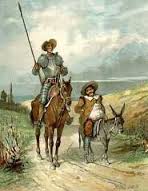 Don Quixote is a fictional character famous for fighting windmills and doing other absurd things. His basic story is one of taking a fantasy world and trying to imprint it onto the real world. The results are comedic for the outsider but almost tragic for Quixote himself. As I was reading his story in college, I always pictured him sitting Indian style in his armor with a child’s toy box trying to hammer the square peg into the round hole. It is easy to label Don Quixote as a “fool” but personally I identified strongly with the character and his trials. Around the time that I read the book, I was on my own Quixotic adventure that put my mental image of the world into question.
 The world is filled with things that cut. Like walking through a patch of thorn bushes with exposed skin, injury is an almost certainty. In the short term, bandaging the cuts is the right strategy. In time, the wounds will heal. If too many cuts pile up, the bandages become wrappings. You become a mummy. Movements constrained by the bandages on wounds that never healed. Avoiding cuts completely is an impossibility but choosing a new path and learning how to wield a machete are both options. Band aids are not a long term solution, they are a short term fix. This concept is obvious when thinking about real wounds but with metaphorical wounds, this is a common strategy.
 Seinfeld is one of my favorite TV shows of all time. It has so many memorable episodes and characters. Despite my love for the series, I’m not a huge fan of the early episodes. Many of the episodes, I just don’t find funny at all or they feel forced. This is not surprising in the slightest. It took those early episodes in order to get to the later ones. Early failures lead to better episodes later. A few of the story-lines were even repeated with better effect the second time around. The early episodes of Seinfeld were not a good indication of where the series was going.
 Despite all of the examples of enduring early hardship, there is still a pervasive desire for instantaneous results. People want to be hit right away, if not sooner. The perception of overnight success is usually due to the glossing over of the hard work done before the big break. Sylvester Stallone was a breakout start with Rocky! After he was a starving actor who had to deny a big pay day in order to star in his own movie. J.K. Rowling had the blockbuster Harry Potter book series followed by movies. After she was on welfare and had her book rejected by many publishers. Most of us are looking for the triumph without the trials. It seems that it doesn’t usually work that way.
 For the past six months or so, I’ve been learning Polish using a program called Duolingo. It is a completely free online language learning tool. I started using it to prove the point to my students that you can learn a foreign language by using such a tool. When summer hit, I took a Polish hiatus but now I’m back on the train. The funny thing is that I’m not sure that I’ll ever get to Poland. It is the homeland of my ancestors and I love to travel but it is not a huge priority. So then why bother to learn the language? There is no foreseeable return on my daily investment of time and energy into this language.

