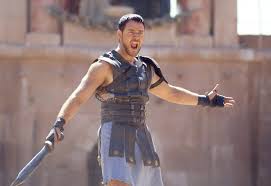
 It wasn’t a 100% binary equation. Gladiators could win, lose or “tie”. Not even all of the defeated were condemned to death. Despite these extenuating circumstances, one thing is most definitely certain, bad gladiators died. I have no desire to bring back gladiatorial games or anything of the sort but in some ways our pendulum has swung too far in the other direction.
In modern society the crowd would seemingly want every gladiator to feel like a winner. Swords would be made of foam rubber but helmets would still be worn just in case. Gladiators would be paired by skill level and the most likely death would come from boredom of the truly talented gladiators. While I am not a fan of truly “zero sum games”, there have to be stakes. Gladiators got good because they had to. Everyone knew that bad gladiators die, the gladiators knew this best.
By all accounts we do not live in a gladiatorial society nor would I truly want to. A bloodthirsty mob looking to revel in the pain of the vanquished is not where we need to go. However a world without stakes has no incentive to move forward. The same holds for an individual. What is at stake for you today? Have you set yourself up in a game where you can win, lose or tie? Or is nothing at stake today? Are you armed with your foam rubber sword hacking away at the same meaningless opponent that you fought yesterday? Bad gladiators of the past got to die quickly. Bad gladiators today die slowly while trying to reassure themselves that they would be lethal if not for this foam rubber. The price of finding out if you’re good or not is to risk the possibility of dying on the metaphorical sword. That might be embarrassment, finances, time or many other things but something needs to be at stake. So step into the arena, put something on the line and see what you’re made of!
The credit belongs to the man who is actually in the arena!
Pete
 It is not an uncommon thing at all to wish for a future that is yet to come or a past that is long gone. Humans have the blessing and the curse to be able to mentally exist in the past and future while ignoring the present. It is a blessing because it allows us the freedom to live in the most useful plane. The curse is the propensity to relive or project the worst of experiences or possibilities. At all times, the mind has the capability of transporting the self elsewhere. With this ultimate power to determine much of our existence, surprisingly most people defer control to the moment or to their “monkey mind”. Imagine if you will driving a car with no steering wheel. The gas and the brakes are great tools but without the ability to steer, one is at the mercy of the terrain and the tires.
 The world seems to be in a never-ending search for balance. While finding this balance is difficult it seems to come most naturally from the pull of opposing forces rather than the migration toward a middle ground. Magnetism, life cycles and so many other phenomena are based on the polarity of their systems. At a certain point human beings should be anticipating the balancing forces of nature but instead we seem to fight it at every turn. Such is the case with learning, especially in the modern world. I’ve encapsulated this concept using the fast moving but rigid rails of trains. The other part to the idea consists of trails which are more free-form. Until recently I was not able to articulate the balance inside of my own head or for outward expression.
 Intuitively I know that the education system is at best flawed and at worst broken. Much like the rails of the train, it can only go to specific destinations and relies heavily on schedules and uniformity. There may be first class and express ticket options available but the destinations are largely the same. The conductors of this system scoff at those who travel by any other means because they’ve become so enamored with their efficiency that they accept its limitations.
 I would not have been surprised if I annoyed the hell out of my former teammates. It’s not that I’m a bad player, I’m actually OK (or was). The annoying factor would come from two things in particular. First, I never shut up. I talk incessantly. Almost as if I were the unofficial play by play announcer for our team. The other would be my tendency to blame everything that went wrong on myself. Regardless of how small of an influence I had on a situation, I tended to focus on my little component rather than anyone else’s. If a goal was scored, it was almost always followed by an admission of guilt. As an intelligent human being and player, I realize that not everything that went wrong was my fault. It’s just not true. However I always wanted to exhaust the thumb before I went to the finger.
 Lately I’ve been thinking a lot about the old school gods and their importance in the lives of our ancestors. Although we have so many technological and societal advantages, there are some aspects to their belief structure that could be helpful if implemented. I’ve joked several times that I may start worshiping Zeus and the other Greek gods because of their idiosyncrasies. You’re less likely to beat yourself up over work snafu when your god is regularly cheating on his wife. Despite the possible comedy arising from this, I don’t know that there’s much to it. The main area that most of the ancient religions have in common is the concept of “sacrifice”. I will be focusing on the non-human variety.
 Imagine it. A soldier walking through a jungle in a foreign land just as the rain stops. In the distance there is a rainbow. All of the sudden there is an attack from the enemy. The attack is repelled and the soldier marches on. The next day the rain stops, rainbow, surprise attack. This pattern continues for a week. On the eighth day, the soldier comes upon a beautiful waterfall. With the water plummeting from a height of over fifty feet, a mist above the surface of the water forms a miniature rainbow and soldier discharges his weapon several times into the falling water. There is no attack, so the soldier is sure that the enemy is dead. It is ridiculous, isn’t it? The soldier believing that the rainbow somehow caused or could help the prediction of the attacks. The truth is that we all do it at one point or another.
 The ability to see past the obvious and simple solution is not one that everyone possesses. Judging books by their covers or even first chapters is not always the best strategy. Not everything in the world is completely formulaic. Even some chemical formulas require a catalyst to increase the rate of their reaction. Despite these facts, there is a solid majority of people that believe the obvious answer is the only possible answer. One of the main reasons is that it is comfortable. Comfort is probably the ethos of our age. So the reason that I asked you not to read this blog is that I want you act on it.
 Have you ever woken up from a night of intense dreaming and not been able to remember much of anything about the dream? Well that’s not what I’m talking about at all! I’m talking about your dreams forgetting you! Those things that you want to have in your life: a goal, a person, an item or anything else you can imagine. It started as an image in your head. Then you took some form of action to make it a reality. You might have even got close. But then it was gone. Sorry to say, your dreams have amnesia!
 Despite being a 41 year old man, I really like the Harry Potter movies and watch them regularly. My wife would say that it’s because of Emma Watson but that’s not quite the truth. The story itself is what draws me in. It’s a pretty classic story of good vs. evil with enough twists and turns to make it unique. I’m also very interested in young people and how they learn to find their way through the world. Obviously completely fictitious but in parallel to the real world, one major failing of Hogwarts is to maintain a consistent Defence Against the Dark Arts teacher. In that world, the imminent danger of Voldemort made that post important. In our much less magical world, the danger does not come from a completely evil dark lord but rather other young people trying to find their way in the world.
 In the real world, young people are increasingly living their lives in a virtual world where the perceived becomes as important or more important than the real. So they are fighting in a world of perception when they are still learning how to perceive themselves. If you know of someone who is struggling to manage the world, here are some starting points:
 One of my bucket list items is completely out of my control. I want to see the US Men’s National Team win a World Cup before I die. While I believe this is completely achievable, it will take some doing. There are many moving parts to this endeavor both on a national and an individual level. Although I am sure that USSF policies will influence the speed at which this goal is achieved, the greater shift will need to be a cultural one. Those types of shifts happen in small groups first, then extend outward. Since the children of today are going to be the major influencers of future culture, my plea is “Don’t think that Messi is special!”
 Huryk Unlimited