 In this extremely fast paced world, it’s easy to get distracted from that which is important in favor of that which seems important. It is the reason why we make shopping lists and set reminders for ourselves. Getting caught up in the moment is not only normal, it seems to be a way of life. Despite all of the technological and societal distractions, it would seem as though we might have accidentally thrown out all of our babies in order to make room for more bathwater. Perhaps it is time to decide what is truly important and focus on it.
There are plenty of people who will get married this year. They will painstakingly search for a great venue, a photographer, delicious food, the right guest-list and register for the perfect gifts. But before they did all of that hard work, they forgot to find someone worth spending their life with.
We have access to amazing communication devices in our pockets and at our fingertips. There is the capability to reach the other side of the world, translate to almost any language and do it instantaneously. But we rarely say things that mean much of anything. There is so much coming at us that it all becomes devalued. We tend to only listen in order to respond, not to understand or empathize.
Students and teachers are no longer bound by the bricks in the walls of their buildings. All facts are available at a moment’s notice and the greatest minds are within reach. Yet our young people are worried about grades that will soon not matter and facts that have little value. The word educate comes from the root educe which means to bring out or develop. The cramming information in might not be the best way to draw out our young people’s genius.
These are just three examples where we seem to be so caught up in the process that we have forgotten why the process was invented. When broken down to the core, the world is a relatively simple place. We are here to survive first. Once that is taken care of we look to progress and we do both more effectively together. So get back to the core of what you do and why it is done at all. If you are in school, then learn, regardless of the grades. If you’re in a relationship, then relate, give of yourself and be willing to be changed. The superficialities of life can only sustain us for so long. Our true progress depends on depth of experience and it needs to be found again. Right now are you focused on ANYTHING BUT THE THINGS THAT MATTER?
Pete
 There are plenty of commercials from my childhood that stick out. Growing up at the beginning of the Super Bowl Commercial craze gave us plenty of memorable advertisements. “Where’s the beef?” from Wendy’s. Bird vs Jordan shooting contest. This is your brain on drugs. These all caught my attention because they were either clever or memorable for positive reasons.
 Stories are an integral part of our society and have been for thousands of years. Whether the Odyssey, the Bible, Star Wars or Romeo & Juliet, the stories of the present and past have almost all been intended to tell us something. Not particularly something about the past although many are historical in nature. More often than not, stories are trying to tell us something about the human condition. Although a form of entertainment, they can also be instructive.
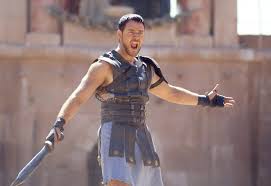 It wasn’t a 100% binary equation. Gladiators could win, lose or “tie”. Not even all of the defeated were condemned to death. Despite these extenuating circumstances, one thing is most definitely certain, bad gladiators died. I have no desire to bring back gladiatorial games or anything of the sort but in some ways our pendulum has swung too far in the other direction.
 Imagine it. A soldier walking through a jungle in a foreign land just as the rain stops. In the distance there is a rainbow. All of the sudden there is an attack from the enemy. The attack is repelled and the soldier marches on. The next day the rain stops, rainbow, surprise attack. This pattern continues for a week. On the eighth day, the soldier comes upon a beautiful waterfall. With the water plummeting from a height of over fifty feet, a mist above the surface of the water forms a miniature rainbow and soldier discharges his weapon several times into the falling water. There is no attack, so the soldier is sure that the enemy is dead. It is ridiculous, isn’t it? The soldier believing that the rainbow somehow caused or could help the prediction of the attacks. The truth is that we all do it at one point or another.
 The ability to see past the obvious and simple solution is not one that everyone possesses. Judging books by their covers or even first chapters is not always the best strategy. Not everything in the world is completely formulaic. Even some chemical formulas require a catalyst to increase the rate of their reaction. Despite these facts, there is a solid majority of people that believe the obvious answer is the only possible answer. One of the main reasons is that it is comfortable. Comfort is probably the ethos of our age. So the reason that I asked you not to read this blog is that I want you act on it.
 Have you ever woken up from a night of intense dreaming and not been able to remember much of anything about the dream? Well that’s not what I’m talking about at all! I’m talking about your dreams forgetting you! Those things that you want to have in your life: a goal, a person, an item or anything else you can imagine. It started as an image in your head. Then you took some form of action to make it a reality. You might have even got close. But then it was gone. Sorry to say, your dreams have amnesia!
 Despite being a 41 year old man, I really like the Harry Potter movies and watch them regularly. My wife would say that it’s because of Emma Watson but that’s not quite the truth. The story itself is what draws me in. It’s a pretty classic story of good vs. evil with enough twists and turns to make it unique. I’m also very interested in young people and how they learn to find their way through the world. Obviously completely fictitious but in parallel to the real world, one major failing of Hogwarts is to maintain a consistent Defence Against the Dark Arts teacher. In that world, the imminent danger of Voldemort made that post important. In our much less magical world, the danger does not come from a completely evil dark lord but rather other young people trying to find their way in the world.
 In the real world, young people are increasingly living their lives in a virtual world where the perceived becomes as important or more important than the real. So they are fighting in a world of perception when they are still learning how to perceive themselves. If you know of someone who is struggling to manage the world, here are some starting points:
 The discussion of the GOAT is always tough because it brings apples against oranges and people’s personal perspective weighs heavily on their arguments. The comparison of Messi vs Ronaldo could be a more objective conversation but adding Pele into the mix makes things much more difficult. Considering different eras and playing landscapes muddies the waters to the point where the argument says more about what the fan values rather than what the player meant in their own time. With all of those points well established from the outset, I am not at all bashful about nominating my mom as the Youth Soccer Fan GOAT! This is not a son’s love for his mother taken to the extreme. In fact, I thought my mother was one of the worst fans at the time but given years to evaluate and compare, she truly was the best.
 The thought of school being like prison is not a new one. I’m sure that most students have thought it or said it at one point. It’s an easy enough correlation to make: brick walls, questionable food, time to be served and other ne’er do wells in the same boat. Although I’ve visited a prison before, most of my frame of reference comes from books and movies. The most prevalent being The Shawshank Redemption. While this book/movie is completely fictitious, conceived in the mind of Stephen King, there is value in the exercise of comparing the fiction to the reality.
 The one outlier in Shawshank Prison is Andy Dufresne. A former banker that does not endure his time in the prison but uses it. Although his sentence is life, he always has an idea of what he’ll do with his life when he gets out. Slowly and methodically he uses time as his ally to dig his way out of prison and to his desired future. While this makes for a good movie, it is just fiction, isn’t it? A quick read of the story of a young Bill Gates shows a great example of art imitating life imitating art.
