 In this extremely fast paced world, it’s easy to get distracted from that which is important in favor of that which seems important. It is the reason why we make shopping lists and set reminders for ourselves. Getting caught up in the moment is not only normal, it seems to be a way of life. Despite all of the technological and societal distractions, it would seem as though we might have accidentally thrown out all of our babies in order to make room for more bathwater. Perhaps it is time to decide what is truly important and focus on it.
There are plenty of people who will get married this year. They will painstakingly search for a great venue, a photographer, delicious food, the right guest-list and register for the perfect gifts. But before they did all of that hard work, they forgot to find someone worth spending their life with.
We have access to amazing communication devices in our pockets and at our fingertips. There is the capability to reach the other side of the world, translate to almost any language and do it instantaneously. But we rarely say things that mean much of anything. There is so much coming at us that it all becomes devalued. We tend to only listen in order to respond, not to understand or empathize.
Students and teachers are no longer bound by the bricks in the walls of their buildings. All facts are available at a moment’s notice and the greatest minds are within reach. Yet our young people are worried about grades that will soon not matter and facts that have little value. The word educate comes from the root educe which means to bring out or develop. The cramming information in might not be the best way to draw out our young people’s genius.
These are just three examples where we seem to be so caught up in the process that we have forgotten why the process was invented. When broken down to the core, the world is a relatively simple place. We are here to survive first. Once that is taken care of we look to progress and we do both more effectively together. So get back to the core of what you do and why it is done at all. If you are in school, then learn, regardless of the grades. If you’re in a relationship, then relate, give of yourself and be willing to be changed. The superficialities of life can only sustain us for so long. Our true progress depends on depth of experience and it needs to be found again. Right now are you focused on ANYTHING BUT THE THINGS THAT MATTER?
Pete
 Kids pretend all the time. They turn sticks into swords, a backyard into a jungle and anything has the potential to be magical. Then as we grow, it seems to be trained out of us. We tend to see ourselves in finite terms. Our limits are not those of our imagination but rather of our circumstances. We don’t consider the impossible or even the improbable because it has been trained out of us. Pretending is child’s play and most of us consider ourselves too mature to do that. The truth is that we’re all pretenders, we’ve just bought into a more sophisticated game.
 There are plenty of commercials from my childhood that stick out. Growing up at the beginning of the Super Bowl Commercial craze gave us plenty of memorable advertisements. “Where’s the beef?” from Wendy’s. Bird vs Jordan shooting contest. This is your brain on drugs. These all caught my attention because they were either clever or memorable for positive reasons.
 Stories are an integral part of our society and have been for thousands of years. Whether the Odyssey, the Bible, Star Wars or Romeo & Juliet, the stories of the present and past have almost all been intended to tell us something. Not particularly something about the past although many are historical in nature. More often than not, stories are trying to tell us something about the human condition. Although a form of entertainment, they can also be instructive.
 In kindergarten (at least according to my recollection), I was the fastest kid in Mrs. Palma’s class. The reason that I know this is that we often had races across the blacktop outside of the classroom. I won everyone that I ran in. Although my memory is extremely fuzzy about that time period, I can make this statement for a few reasons with little fear of repercussion. First, it’s possible that it is true. I definitely wasn’t the slowest in the class. Second, everyone else’s memory is probably as fuzzy if not fuzzier than mine. Finally and most important, IT DOESN’T MATTER! While this may have been extremely relevant over thirty years ago, it’s importance has taken a nose dive down to zero.
 It was an absolute revelation! Never before and not since had I ever seen a short part of a movie and instantly gone to Blockbuster to rent it (Even more difficult to do now that BB is out of business). The movie was Swingers and the scene was when Mike’s friends are trying to help him with his abilities talking to women. The scene is mildly inconsequential but the idea could be life changing.
 Idols are supposed to be held in high esteem, the very personification of the things that we want to be. It hit me like a lightning bolt this morning that Mr. Magoo is truly an American idol for so many people. For those youngsters out there, Mr. Magoo was a cartoon character whose poor eyesight routinely got him into precarious situations but he always escapes unscathed and sometimes falls into good fortune. Feel free to watch one Mr. Magoo cartoon on YouTube. Once you’ve seen one, you’ve basically seen them all (minus little details). The overarching idea behind Mr. Magoo is that his problem would be easily fixed if he were just to put on his glasses but he wants to deny his problem rather than face it.
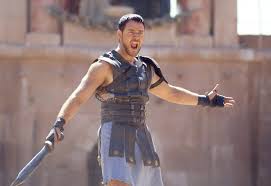 It wasn’t a 100% binary equation. Gladiators could win, lose or “tie”. Not even all of the defeated were condemned to death. Despite these extenuating circumstances, one thing is most definitely certain, bad gladiators died. I have no desire to bring back gladiatorial games or anything of the sort but in some ways our pendulum has swung too far in the other direction.
 It is not an uncommon thing at all to wish for a future that is yet to come or a past that is long gone. Humans have the blessing and the curse to be able to mentally exist in the past and future while ignoring the present. It is a blessing because it allows us the freedom to live in the most useful plane. The curse is the propensity to relive or project the worst of experiences or possibilities. At all times, the mind has the capability of transporting the self elsewhere. With this ultimate power to determine much of our existence, surprisingly most people defer control to the moment or to their “monkey mind”. Imagine if you will driving a car with no steering wheel. The gas and the brakes are great tools but without the ability to steer, one is at the mercy of the terrain and the tires.
 The world seems to be in a never-ending search for balance. While finding this balance is difficult it seems to come most naturally from the pull of opposing forces rather than the migration toward a middle ground. Magnetism, life cycles and so many other phenomena are based on the polarity of their systems. At a certain point human beings should be anticipating the balancing forces of nature but instead we seem to fight it at every turn. Such is the case with learning, especially in the modern world. I’ve encapsulated this concept using the fast moving but rigid rails of trains. The other part to the idea consists of trails which are more free-form. Until recently I was not able to articulate the balance inside of my own head or for outward expression.
 Intuitively I know that the education system is at best flawed and at worst broken. Much like the rails of the train, it can only go to specific destinations and relies heavily on schedules and uniformity. There may be first class and express ticket options available but the destinations are largely the same. The conductors of this system scoff at those who travel by any other means because they’ve become so enamored with their efficiency that they accept its limitations.
