It has come to that time of year where many American football* fans are without a team to root for until the Super Bowl when they hope for good commercials. If you are a soccer fan and have a football fan in your life who is interested in learning about soccer, then I have some tips below. (NOTE: Do not try to convert the unwilling football fan. Save your energy for the father-in-law who has grand-kids that play. Trying to convert the uninterested usually backfires.)
The most incomprehensible thing about soccer to most football fans that I’ve spoken to is the offside rule. Luckily there is a pretty easy way to convey the concept using football terms. The key is to take the rule that they already understand and tweak it to help them understand the soccer equivalent. If you’re not a football person, you might first need to brush up your understanding of the carrying game first.
Offside in football is a foul in which a player is on the wrong side of the line of scrimmage when the ball is snapped. This foul occurs simultaneously with the snap. Unlike offensive players, defensive players are not compelled to come to a set position before the snap.
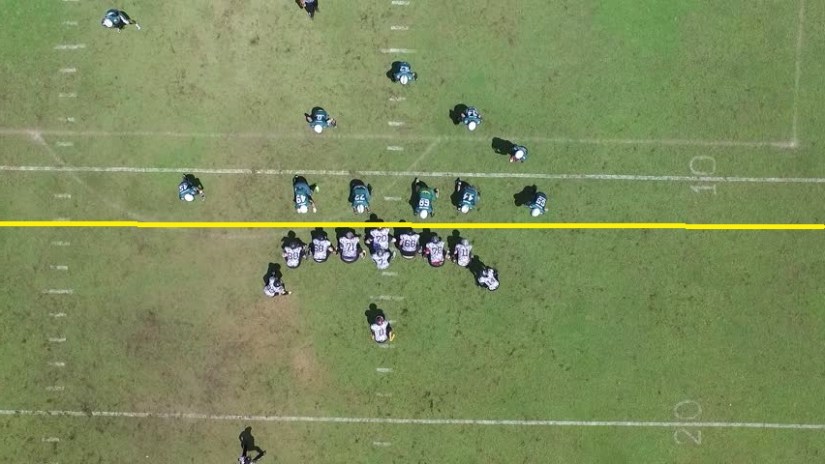
In soccer there is no line of scrimmage nor a “snap” of the ball. Since the ball is almost continuously in play, the rule is a bit harder to police but understanding is all that we’re aiming for now. First of all, only offensive players can be called offside and only in their offensive half of the field (nearest the goal they intend to score on). The line for offside is not a fixed yard line but rather it moves with the last defender** equivalent to the defensive position of safety. (See Below)
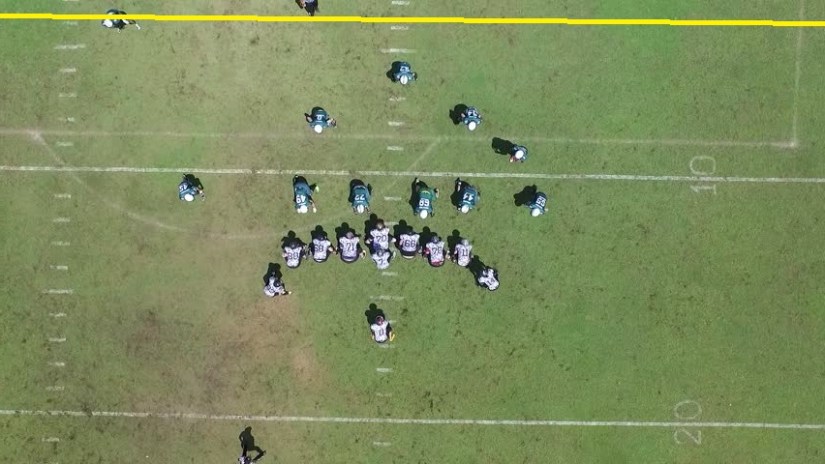
So since the ball is almost always in play, offensive players are moving around and can even cross the offside line. A call of offside is made when an offensive player is in an offside position and the ball is played toward him or her. In football terms, the wide receiver cannot run past the invisible yard line of the safety until the ball is thrown by the quarterback. So the timing of streak (go), post and corner routes need to be timed very well. If the ball is not passed before the intended receiver gets by the “safety”, he’ll be offside. Curl and comeback routes can be effective in keeping a player onside. But if he is offside at the time of the pass, receiving the ball in an offside position doesn’t matter (like a defensive lineman who tries to jump back as the ball is snapped).
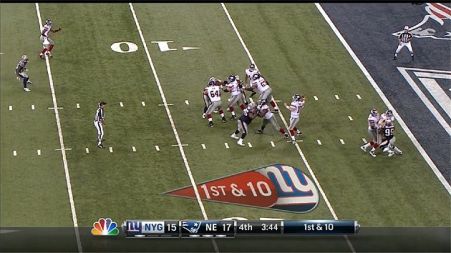
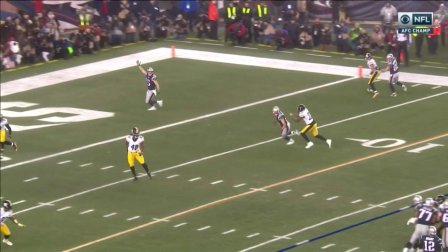
The player possessing the ball cannot be offside. So a player can dribble through the offside line. Therefore if the quarterback or running back carry the ball forward, they are not offside.
That pretty much sums it up. If I’ve missed anything, please leave it in the comments below and I’ll adjust it. Pass this information along to a football fan that cares to learn.
* I don’t like using the term American football but I do it to avoid confusion. I also dislike using one sport to explain another but have done this
**This statement is partially false. The last defender needs to have the goalkeeper behind them. This is something that soccer fans and even referees get wrong from time to time. Two defenders (one usually being the goalkeeper) need to be between the offender and the goal line. If the goalkeeper goes out of the goal a far distance, one defender is not enough to keep an offensive player onside.
 There are plenty of commercials from my childhood that stick out. Growing up at the beginning of the Super Bowl Commercial craze gave us plenty of memorable advertisements. “Where’s the beef?” from Wendy’s. Bird vs Jordan shooting contest. This is your brain on drugs. These all caught my attention because they were either clever or memorable for positive reasons.
 Stories are an integral part of our society and have been for thousands of years. Whether the Odyssey, the Bible, Star Wars or Romeo & Juliet, the stories of the present and past have almost all been intended to tell us something. Not particularly something about the past although many are historical in nature. More often than not, stories are trying to tell us something about the human condition. Although a form of entertainment, they can also be instructive.
 In kindergarten (at least according to my recollection), I was the fastest kid in Mrs. Palma’s class. The reason that I know this is that we often had races across the blacktop outside of the classroom. I won everyone that I ran in. Although my memory is extremely fuzzy about that time period, I can make this statement for a few reasons with little fear of repercussion. First, it’s possible that it is true. I definitely wasn’t the slowest in the class. Second, everyone else’s memory is probably as fuzzy if not fuzzier than mine. Finally and most important, IT DOESN’T MATTER! While this may have been extremely relevant over thirty years ago, it’s importance has taken a nose dive down to zero.
 It was an absolute revelation! Never before and not since had I ever seen a short part of a movie and instantly gone to Blockbuster to rent it (Even more difficult to do now that BB is out of business). The movie was Swingers and the scene was when Mike’s friends are trying to help him with his abilities talking to women. The scene is mildly inconsequential but the idea could be life changing.
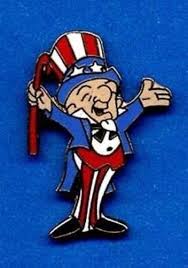 Idols are supposed to be held in high esteem, the very personification of the things that we want to be. It hit me like a lightning bolt this morning that Mr. Magoo is truly an American idol for so many people. For those youngsters out there, Mr. Magoo was a cartoon character whose poor eyesight routinely got him into precarious situations but he always escapes unscathed and sometimes falls into good fortune. Feel free to watch one Mr. Magoo cartoon on YouTube. Once you’ve seen one, you’ve basically seen them all (minus little details). The overarching idea behind Mr. Magoo is that his problem would be easily fixed if he were just to put on his glasses but he wants to deny his problem rather than face it.
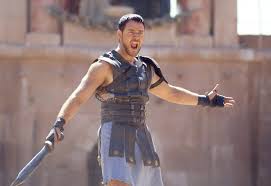 It wasn’t a 100% binary equation. Gladiators could win, lose or “tie”. Not even all of the defeated were condemned to death. Despite these extenuating circumstances, one thing is most definitely certain, bad gladiators died. I have no desire to bring back gladiatorial games or anything of the sort but in some ways our pendulum has swung too far in the other direction.
 It is not an uncommon thing at all to wish for a future that is yet to come or a past that is long gone. Humans have the blessing and the curse to be able to mentally exist in the past and future while ignoring the present. It is a blessing because it allows us the freedom to live in the most useful plane. The curse is the propensity to relive or project the worst of experiences or possibilities. At all times, the mind has the capability of transporting the self elsewhere. With this ultimate power to determine much of our existence, surprisingly most people defer control to the moment or to their “monkey mind”. Imagine if you will driving a car with no steering wheel. The gas and the brakes are great tools but without the ability to steer, one is at the mercy of the terrain and the tires.
 Huryk Unlimited