It’s that time of year again where I make my trip to whatever city is hosting the United Soccer Coaches (former NSCAA) Convention. It is great to spend 4-5 days talking, thinking and learning about soccer. If this is your first time or you’ve never gone, here are some ideas on how to get the most out of the Convention.

- Decide – There’s more than enough going on at the Convention for just about any soccer coach/fan. Deciding what it is that you want to get out of the Convention will get you much closer to achieving that goal. It’s fine to spend some time wandering around the exhibit hall but it shouldn’t be your only activity. Decide on some presenter that you want to see, Bill Beswick is one of my favorites. Decide on the concepts that would really help your team, club or players.
- Don’t be afraid to be a paratrooper – This is my term for showing up to a session and deciding quickly that that topic, presenter or material is not what you were looking for. Don’t be afraid to move on to another session. There’s more than enough going on that you can have two or even three worthy sessions in each time slot. So plan ahead.
- Engage – There are thousands of people here with the same passion as you. The possibility for common ground is immense. Although it may be more comfortable to only talk to the people that you came with, you’ll probably find that engaging with new people creates new possibilities. This does not mean stalk Thierry Henry to pick his brain about how to fix your U9 girls team’s finishing problem. There are more than enough people here who would be eager to talk to you about it though. So step out of your shell.
- Get out of your lane – There are so many facets to this sport on display over the next few days. Sticking to your own area is a great way to leave with the exact knowledge that you had upon your arrival. Make a concerted effort to learn about something outside of your personal “wheel house”. I once attended a panel discussion on club finances. It gave me an insight into the work that my club’s treasurer was doing and helped us to prepare for some future financial concerns.
- Show up – Over the years, I’ve convinced several friends and colleagues to go to their first Convention. Almost all of them are now yearly attendees. There are many people in the soccer community that were disappointed by the qualification failure of the USMNT. That problem will not be solved at this Convention. However the solutions to American soccer problems will come from many of the people and ideas that are here. As I hope that we’re beginning to see in many areas of life, a better tomorrow is not dependent upon the chosen few at the top. It is incumbent on all of us who care to show up early and often to help get things right.
Baltimore is one of my favorite cities! The Convention Center is in the Inner Harbor area which has a lot of great restaurants. If you feel like getting out of the area where all of the soccer people are, you can head over to Fell’s Point or Canton. Those areas have slightly more local feel. Looney’s is my personal favorite. I go there for the crab melt! Enjoy the Convention!


 It has been said many times that soccer is a “religion”. While this may be taken as an exaggeration or possibly a slight against religion, there is reason to take the claim with a certain amount of seriousness. Although the sport does not call for the fealty to a superhuman controlling power, it could be considered a form of faith and worship. Routinely throughout the year, people flock by the thousands to sport cathedrals to have their faith tested by the team of their choosing. Much like a religion, an individual must decide to keep believing in the face of conflict. Although the teams, managers and players are the facilitators, it is actually the mass’s belief in the sport itself that makes it most like a religion.
 Things were different before the internet. There’s just no denying it. I told a group of young people recently about how we used to caravan to soccer games. Most of the group of parents would meet at a predetermined spot and follow each other to the location of the game. It may seem ridiculous by the modern day standard. Ten cars following each other down the highway to reach a youth soccer game. That was just how things were done. The positive side was that we combined cars a lot. People would ride together. One of my best friends from that time came from the fact that his mother didn’t like to drive on highways. So he and his mother would ride with us. So even though it’s not how we do it now, it had its virtues.
 Growing up playing soccer in the 1980’s was kind of like the Wild West. Not everyone fully understood the rules. Cultural norms were not fully established or recognized. Those players/teams who had a parent or relative who understood the game were an anomaly and an advantage. The first unwritten rule that I learned was “if you wore white cleats, you’d better be the best player on your team or even the field”. I learned this by accident because I wore white cleats for a season when I was young. They weren’t my choice. My mother bought what was cheap and these were definitely cheap! Either Patrick or Wilson, I don’t even recall. If anyone can tell by looking at the photo please put it in the comments below. Regardless of the brand, my attire sent off conflicting messages to people who understood. The color of my cleats sent the message, “I’m the best”. The fact that they were cheap said, “I don’t have the best tools (either through poverty or ignorance)”. My play sent the message “I don’t realize that I’m sending any messages!”
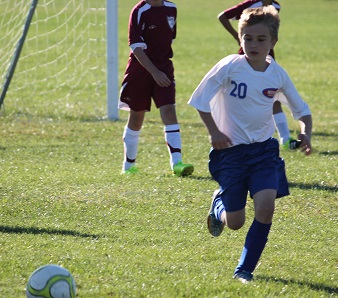
 Today my son’s game had an extremely good referee group. The center referee and his two linesmen called the game very well. Despite the fact that they did a great job and got the majority of the calls right (even the ones that went against my son’s team), there were still complaints from parents. Which made me wonder if people really have any idea what makes for a good referee or if they just want calls to go in their team’s favor? Here are some thoughts to consider.
 I am your new coach. That’s a role that I take very seriously. It’s a mixture of teacher, mentor, psychologist, personal trainer, confidant and many other jobs that coalesce into a position of great possible influence. The word possible is in there because people are put into roles like this every day but just because someone leads does not mean that anyone will follow. A position of power does not make someone a leader. Leaders must be willing to go first. My hope is that I am able to prove beyond a shadow of a doubt that I am.
 Huryk Unlimited