 Today my son’s game had an extremely good referee group. The center referee and his two linesmen called the game very well. Despite the fact that they did a great job and got the majority of the calls right (even the ones that went against my son’s team), there were still complaints from parents. Which made me wonder if people really have any idea what makes for a good referee or if they just want calls to go in their team’s favor? Here are some thoughts to consider.
The level matters – Recognize that the job of a referee changes as the age and the level of play changes. At the lowest levels, the referee is part of a learning process. Their job is more about managing the understanding of the game rather than calling “fouls”. Often the sidelines are complaining about things that are poor body control and not actually a foul. The higher levels require much more reading of the flow of the game. A good referee will identify possible problems developing in the play. Their use of cards, advantage, player discussions and fouls called/not called will depend largely upon their reading of the game and individual’s roles within in it. So as you are watching a game, give some thought as to the level of soccer being played and what the referee’s role truly is at that level.
Perspective matters – By design, referees are intended to be a neutral third party at the game. So they are not carrying the bias that most of us bring to the game. Their decisions are based upon what they see and not what they feel. This creates another issue for most fans because their vantage point is completely different from that of the referee’s. So it is not only possible but actually completely accurate to say that fans and referees have seen a different game. Most of the time this is done with no instant replay, no VAR with different camera angles. This is done live with twenty two players running in all directions and possibly screening the view. Despite these major obstacles, perfection is the standard that many expect.
The Laws are the Laws – A good referee will call the game based on the laws of the game, not public perception of what the laws are. There are many things that are commonly shouted from fans or even coaches about things that do not apply to the Laws of the game. “Winning the ball” for example does not make a player immune from having a foul called against them. If the play is deemed to be reckless, then a foul is appropriate regardless of who won the ball. A large number of players, fans and coaches have only a cursory knowledge of the Laws that are based more on hearsay rather than actual study.
Obviously this is just a small sample but each is worth considering. The game requires referees and the good ones need to be identified, praised and promoted. I fear that many people involved in the soccer world would not be able to identify a good referee if they saw one. That is unfortunate because that means that people are unable to see past their own desires. Most of the soccer played in this country is youth soccer. Therefore the majority of children are getting a skewed view of right and wrong. Right means in my favor and wrong means anything else. The ability to be objective could be lost.
 In the modern world, there is a certain leaning toward being self-centered. The pervasiveness of selfies in the social media world sends the message, “Look at me, I’m special.” While I truly feel it is important for people to believe in themselves, things that go too far to one extreme tend to become their opposite. Too much of a lifesaving drug becomes poison. Too much focus on weight loss becomes anorexia. Too much focus on the self becomes narcissism. The key to balance is a counterweight. Brian McBride seemed to have that balance figured out perfectly.
 I remember playing soccer as a kid pretty vividly. There’s a smattering of games, practices, camps, travel and associated activities swimming around inside my head. Perhaps I’ve forgotten but there was only one time that I ever considered “quitting” soccer and that was near my transition to high school. However that was because I was considering going out for football. So other than that, I truly don’t have a recollection of not wanting to play anymore. Perhaps I’m wired differently because I also ran track through high school and into college. Basketball got left behind as a sophomore in high school. That was more of a “talent” and interest thing than burnout. When you’re getting the token minutes as a freshman, the writing is on the wall. I needed to get a lot better in order to be successful at the sport that was not my priority.
 Every weekend the players line up on the field, the referee blows the whistle and the microscopes come out. I’m speaking figuratively of course. Although a fusion between youth sports and science would be great, I’m talking about the tunnel vision of the fans on the sidelines. It’s actually not their fault. It is in our nature to pay attention to the things that we care most about. So a parent’s focus on their child at a time of high emotion is both normal and expected. Our youth sports culture has definitely swung toward the extreme with cost, intensity and behavior. The thing that we often lack as we go through life is perspective. We tend to think that the way we perceive the world is the way that the world is. It is only our version. There are billions of others and none of them is completely correct either. So it may be valuable to gain a different perspective.
 I’ve not watch a NFL game for about four years. I used to love it but now I can’t
  The spring season brings rejuvenation and tryouts. Soccer tryouts, hockey tryouts and I’m sure many others. The constant evaluation of players is now a cultural norm. While it may seem like a necessary evil, it is our job as the adults or forward thinkers to ensure that it doesn’t become pure evil in the mind of a young player. The constant question can go swirling through their head “Am I good?” While it may be a common question, it is probably the wrong question.
 In “The Junk Mail” episode of Seinfeld, we are introduced to Frankie Merman. He is Jerry’s childhood friend who has many quirks including digging holes to sit in when he is upset. Despite his eccentricities, George is slightly jealous of Frankie because Frankie and Jerry attended camp together. George ruefully refers to Frankie as the “Summer Me”. He even goes so far as to lie to Jerry about an imaginary summer friend of his own. All of this ridiculousness is par for the course in the world of Seinfeld. As far fetched as it all may be, it got me thinking about the soccer world in which American fans live.
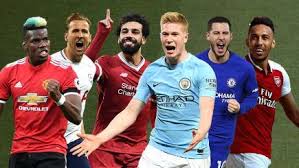 Next weekend marks the end of the Premier League. For those who religiously follow teams from England on Saturday and Sunday mornings, there is hole to be filled. Recognizing this fact, it might just be time to embrace Major League Soccer as your “Summer League”. I can hear the protests now, “MLS sucks!” “There’s no promotion or relegation!” “It’s a retirement league!” I’m well aware of this and all of the other vitriol that comes out whenever someone suggests that our domestic league should be watched by our domestic fans. I understand the thought process. My son and I just took a trip to England to see two matches. The allure of European soccer is not lost on me. The only question is do we want it to be this way? Do we truly want to be thousands of miles away from the best soccer in the world? Americans account for the largest number of ticket buyers at the World Cup, other than the host nation. Which means that we travel to far off lands at great expense to see the best in the world compete. In 2026 when the World Cup is here, will Americans not attend the games because they are here? That would be a ludicrous thought! We want the best games with the best players to be in our backyards. BUT we’re impatient, entitled and shortsighted. Let’s take a look at each.
 We’re impatient. Major League Soccer is barely 20 years old. Even the re-branded version of the English first division is older by around 4 years. Comparing MLS to any of the historic first divisions from Europe is at best an apples to oranges comparison. At worst, it ignores all common sense. Teams and leagues are made up by players and their endeavors are supported by fans. European fans have supported their clubs for generations. MLS clubs have not existed for a generation yet. Love for a team or club is not built overnight. It is a slow process and we’re in the thick of both the development of love for clubs and a talent pool. If the desire is that MLS should just buy the best talent in the world, do some research on the Cosmos.
 We’re entitled. Other than MLS, the other major sports leagues based in the US are arguably the best in the world. NFL, no competition. MLB, takes whatever talent is produced in other leagues. NBA, second tier talent from the US go to play in the other leagues. NHL, brings in talent from all over the world. Is it really that disheartening to have one league of the top five major sport that is not
 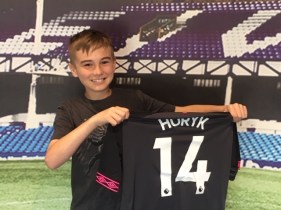 The Beatles may have been right by saying that love can’t be bought but the purchase of a new jersey of your son’s favorite team does help. Our first stop was in Liverpool for the Everton vs Manchester United match. We had a day to tour around the city a bit but most of our time was spent at the club shop and taking photos near the two stadiums of the city’s rival teams. Despite leaning toward Liverpool in the past, I had to stick with my son in his support of the Toffees. It was not an easy thing to do since the first English player that I ever knew by name was Kevin Keegan. Remember that I was raised in an era before the internet, so VHS instructional videos on soccer were my introduction to international soccer. However keeping with my overall thought process, supporting Everton makes much more sense for me. I tend to choose the road less traveled. Regardless, on match day it seems that I made the right choice. Everton pummeled the Red Devils from start to finish. It seemed as though ManU was expecting the Toffees to roll over and die. My son got the perfect introduction to live football in England, coincidentally 4-0 was the same score to the first POSH match that I ever attended.
 With my young son in tow, I could not take part in everything that football culture has to offer. I did take the time to visit the home of PISA at Eb’s. We didn’t stay long and I only had one beer but I felt like I needed to show up and see what was going on. I really should have coordinated better with some of the people on londonroad.net. It would have been nice to put faces with screen names but this was a last minute decision because I did not know what to expect from the place. It was actually the perfect place to go prior to the match. The food looked and smelled good. The memorabilia around the place was a good retrospective on some of the reasons why I’m a POSH fan now.
 The match itself was preceded by a “First Time Fan” experience. My son got the chance to sit in the team seats and high five the players on their way out to the warm-up. For me it was an opportunity to be a few feet away from two POSH legends: Aaron Mclean and Darren Ferguson. Although I must admit that I dropped the ball on getting photos with both. As a coach I just couldn’t bring myself to interfere with pregame preparations. Despite that fact, I still enjoyed the experience of getting down on the field level and seeing the players up close.
 Prior to the match, the man who lead the “First Time Fan” activities had said to the group, “If we win, you need to come back because we won. If we tie or lose, you need to come back to see a win.” Although the game ended in a draw, it was still a great experience for Luke and I. I would have preferred three points and a dominant performance like I got during my last visit to London Road but this was special in its own way because I was there with Luke. We will will be back at some point and hopefully it won’t take a decade this time!
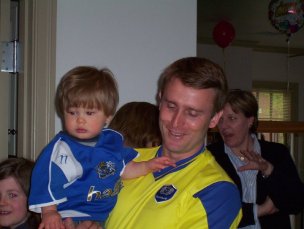 After playing the game with the POSH for a while, I decided to look into how the team was in real life. It was very casual at first but the season they got into a relegation battle really drew me in. After that I followed the team regularly online by reading the match reports and checking Skysports.com. The POSH forum at LondonRoad.net was another way that I got information relevant to the club. The slow burn of my love for POSH got a large log thrown upon it in September of 2006 when Darragh MacAnthony became chairman of the club. He stated that his ambition was to do exactly what I had done in the video game world. If I wasn’t hooked before, I was all in at that point. My newborn son had a full kit and I wore POSH blue (or bright yellow) regularly. In addition to game days, I wore the POSH colors whenever I ran long distance races.
 In 2007 I decided that it was time to visit London Road to attend a match. It was possibly the most frugally planned trip that I could arrange. I was in England for three nights including one in a basement room of a one star hotel in London. It was an amazing trip! The main reasons that the trip was amazing were all POSH related. The team beat MK Dons 4-0 despite Shane Blackett getting sent off in the second half. After the match, I waited around for autographs from the players and coaches. Shwan Jalal and Craig Mackail-Smith were particularly nice to me. Unfortunately I did not get to meet the new manager, Darren Ferguson. At that moment, I mainly knew him as Sir Alex’s son. Eventually he would become one of the best POSH managers by putting Darragh’s plan for promotion into effect. By signing ambitious young players and putting them into a system that created boatloads of goals, he has become my favorite manager.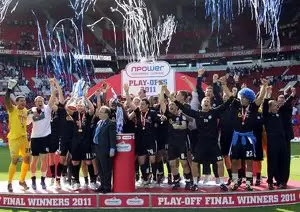
 Huryk Unlimited