Uncategorized

Soccer in American Football Terms: Offside

It has come to that time of year where many American football* fans are without a team to root for until the Super Bowl when they hope for good commercials.  If you are a soccer fan and have a football fan in your life who is interested in learning about soccer, then I have some tips below.  (NOTE: Do not try to convert the unwilling football fan.  Save your energy for the father-in-law who has grand-kids that play.  Trying to convert the uninterested usually backfires.)

The most incomprehensible thing about soccer to most football fans that I’ve spoken to is the offside rule.  Luckily there is a pretty easy way to convey the concept using football terms.  The key is to take the rule that they already understand and tweak it to help them understand the soccer equivalent.  If you’re not a football person, you might first need to brush up your understanding of the carrying game first.

Offside in football is a foul in which a player is on the wrong side of the line of scrimmage when the ball is snapped. This foul occurs simultaneously with the snap. Unlike offensive players, defensive players are not compelled to come to a set position before the snap.
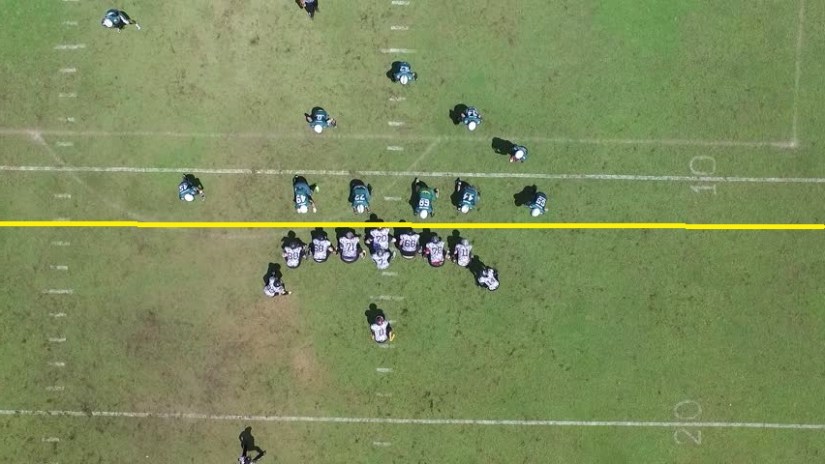
FootballOverheadScrimmage

In soccer there is no line of scrimmage nor a “snap” of the ball.  Since the ball is almost continuously in play, the rule is a bit harder to police but understanding is all that we’re aiming for now.  First of all, only offensive players can be called offside and only in their offensive half of the field (nearest the goal they intend to score on).  The line for offside is not a fixed yard line but rather it moves with the last defender** equivalent to the defensive position of safety. (See Below)
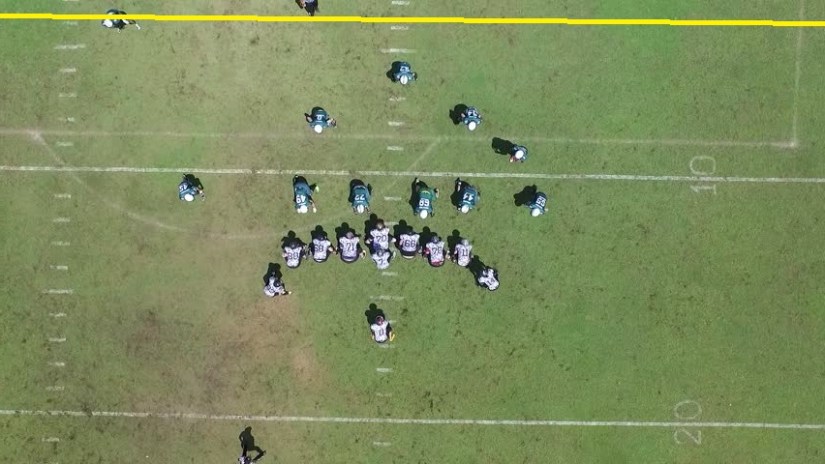
FootballOverheadSafety

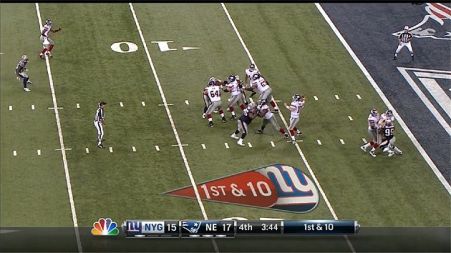
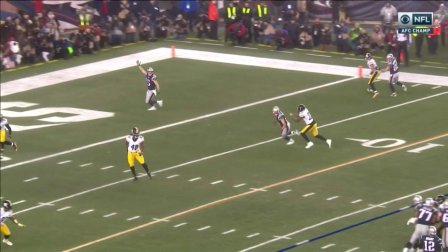
So since the ball is almost always in play, offensive players are moving around and can even cross the offside line.  A call of offside is made when an offensive player is in an offside position and the ball is played toward him or her.  In football terms, the wide receiver cannot run past the invisible yard line of the safety until the ball is thrown by the quarterback.  So the timing of streak (go), post and corner routes need to be timed very well.  If the ball is not passed before the intended receiver gets by the “safety”, he’ll be offside.  Curl and comeback routes can be effective in keeping a player onside.  But if he is offside at the time of the pass, receiving the ball in an offside position doesn’t matter (like a defensive lineman who tries to jump back as the ball is snapped).
FootballOnside
The Receiver on the 15 yard line is onside at the time of the pass.
FootballOffside
The player in the end-zone is offside because he’s beyond the last defender at the time of the pass.

The player possessing the ball cannot be offside.  So a player can dribble through the offside line.  Therefore if the quarterback or running back carry the ball forward, they are not offside.


That pretty much sums it up.  If I’ve missed anything, please leave it in the comments below and I’ll adjust it.  Pass this information along to a football fan that cares to learn.

* I don’t like using the term American football but I do it to avoid confusion.  I also dislike using one sport to explain another but have done this

**This statement is partially false.  The last defender needs to have the goalkeeper behind them.  This is something that soccer fans and even referees get wrong from time to time.  Two defenders (one usually being the goalkeeper) need to be between the offender and the goal line.  If the goalkeeper goes out of the goal a far distance, one defender is not enough to keep an offensive player onside.

SoccerLifeBalance

80’s Hair Band Soccer Logic

PoisonAlthough the 1980’s were memorable for many reasons, the crazy hair is probably one of the most prevalent.  Big hair was all the rage at the time.  Many of the 80’s rock bands invested a lot of time and money on their hair.  Image was almost more important than the music.  I’ve even heard interviews with bands who tried to gain information on the hair products of more successful bands in order to copy their formula.  It’s a silly image isn’t it?  Grown men hanging their hopes of musical success on the type of hairspray that they use.  There is a disconnect that should have been obvious to all involved but sometimes people are too close to the situation to see their own ridiculousness.

A similar phenomena is rampant in the soccer world and a good hard look in the mirror is more than overdue.  Each and every week, millions of kids and adults practice their skills of passing, dribbling, heading and shooting.  Coaches spend hours trying to help these players improve their skills and coalesce the group’s talents into tactics.  Meticulous care is given to all facets of the game including set plays on both the offensive and defensive side.  After hours of preparation, game day finally arrives.  The first whistle blows and that training seems to take a backseat.  It’s overshadowed by telling the one person not displaying any soccer skill about how badly he or she is doing.  The referee takes center stage in a contest that should be focused on the soccer skills of the players.  Much like the hairspray obsessed rock bands, the coaches, players and fans have taken something that should be incidental and made it THE big deal.

Having been a high school and youth coach for years, I’ve seen the lower level of refereeing on display.  While frustrating at times, the arbiter of the game should not overshadow all of the preparation that has been done.  Here are some suggestions that I have to put refereeing in its proper context.

  1. Audit yourself – If more than 25% of the things that you say are directed at the referee, then you’re focused on the wrong thing.  Your players need guidance, your teammates need information, your children need encouragement.  The referee does not need more reminding that you have disagreed with all of his calls.
  2. Walk a mile – Not literally but figuratively.  Get certified and start refereeing some low level games.  Or referee a scrimmage between two teams that you’re not associated with.  Either way the experience will change how you view the job.
  3. Try a new strategy – Rather than berating the next referee that you encounter, try something new.  If you’re a player, in a calm voice during a stoppage, ask him or her to watch for something that has been happening regularly.  “Sir, could you keep an eye out for #15 fouling after the play.  Thanks!”  If you’re a coach, ask the referee to remember a particular foul or incident for discussion later.  If you’re a fan, concentrate on the play of your team.  This is what your team has worked for, see their play.  Otherwise it’s like going to an opera but spending all of your time focused on the conductor’s outfit.  He’s supposed to be invisible.
  4. Recognize the long term – Donuts in small quantities are not by themselves dangerous.  If they are a small part of an otherwise balanced diet, the occasional treat is not harmful.  However constant abuse can be destructive.  The same is true for our refereeing situation.  The constant abuse of referees has led to a shortage that eventually could cripple the game.  That position has to be held by a human.  Who would sign up for the pervasive abuse that referees receive?

So as you prepare for this weekend’s contest, make a decision to focus on the game rather than the official.  After over 35 years of playing and coaching there are exactly two things that I’m sure of:  1.  All referees make mistakes.  2. They don’t get better or change their calls because you tell them that they suck.  For the love of the game, let’s all try to do better out there.  The hair bands can look back and be amused.  Let’s not all look back and be ashamed.

Pete

It’s a bit older now but still a good message from the English FA.

Blogpost, SoccerLifeBalance

I’d Bench Pele IF…

PeleTalent is coveted, scouted, poached and revered in this country.  It often comes with an extremely high price tag.  That price is monetary in the professional ranks.  However at the lower levels, the price of talent is far too often the possibility of teamwork.  At times this comes from jealousy of teammates.  Unfortunately it is more frequently a result of trading team ethos for star power.  It may get results but are they the right ones and for how long?

I’ve often told my teams that “I’d bench Pele if his play didn’t make us a better team.”  Now I’ve never had the pleasure of coaching the Brazilian star (nor would he need me) but that statement has usually followed the benching of a talented player for putting him/herself above the team.  The unfortunate thought that is going through several people’s heads at the moment is that “a great player always makes a team better.”  How I wish that were true but I know that it is not.

Talent does not exist in a vacuum.  It comes attached to a person who has a narrative inside of his/her head about what their talent means.  For some it makes them a large gear in the machine of the team.  While others tell themselves a story that the team is “nothing” without them.  In my preferred sport of soccer, I’ve never seen this to be true but I know it has been thought.

The key to a coach extinguishing this narrative is to swallow the hard pills at the right times.  Recognizing when a talented player has forgotten they are part of a whole and have them sit to consider that point.  Knowing when a player has “outgrown” a team and let their talent go.  These are the types of decisions that are good for the long term of the team and the player but difficult in the moment.

The stories that we tell ourselves are important.  They frame the world into a model that makes sense out of our personal experience.  There are billions of stories going on around the world.  My personal belief is that the accuracy of the story is not as important as the helpfulness of the story.  I started off by saying that I’d bench Pele…  I’m never going to be put in that position but it frames a belief system in a way that leaves no doubt to my conviction.  So as you go into your day, what’s your story?  Is the world out to get you?  Are your best days behind you?  Are you the world’s best student?  Is this your breakout year?  It’s only a story and you can keep it if you want to but put it to my test, does it help?

Go add to your story today!

Pete

Uncategorized

Not Hard Work, LABOR!

HHS SoccerMany sports teams are in the middle of their preseason sessions at the moment.  I’m sure that many players are working hard.  It is almost a prerequisite for any level of success in the sports world.  The reason that I hedge is that there is a higher level of effort that is more in line with the actual effort.  That level of effort is called labor.

Work is a scientific or mathematical equation: force x distance = work.  It also has particular connotations in our culture.  Common words that are associated with work are: hard, job, difficult, employment and pain.  While these may be common, I don’t know that I would describe them as positive.  Although we recognize the value of hard work.  Many people would look to avoid it.

The reason that I would change to labor is not because work and labor are synonyms.  It is actually in labor’s secondary meaning that all of the magic happens.  Although many people may make work and labor the same inside of their heads.  Labor is the process of giving birth.  In particular the final part before delivery.  Taken as a whole, the process leading up to and including labor is no picnic.  Talk to almost any mother and there will be stories of morning sickness, discomfort and pain leading to a crescendo of “ultimate pain”.  At this point, work is sounding pretty good!  The difference between the two is that at the end of labor, there’s a miracle to behold.  Almost any mother will tell you that it is the worst pain but all is forgotten in the end.

So as you start any endeavor, go in with the idea that you are going to labor toward your goal.  The pain and discomfort are part of the process toward the eventual miracle that you are looking for.  In the end, the pain will be forgotten and you’ll be able to rejoice in the two things that you’ve created: your goal and the new version of you!

Go labor toward your passion today!

Pete

Blogpost

Greatest Youth Soccer Fan of All Time

img_20170619_0001-e1501554153711.jpgThe discussion of the GOAT is always tough because it brings apples against oranges and people’s personal perspective weighs heavily on their arguments.  The comparison of Messi vs Ronaldo could be a more objective conversation but adding Pele into the mix makes things much more difficult.  Considering different eras and playing landscapes muddies the waters to the point where the argument says more about what the fan values rather than what the player meant in their own time.  With all of those points well established from the outset, I am not at all bashful about nominating my mom as the Youth Soccer Fan GOAT!  This is not a son’s love for his mother taken to the extreme.  In fact, I thought my mother was one of the worst fans at the time but given years to evaluate and compare, she truly was the best.

She didn’t know the game!  Some people might view this as a negative but it was a huge positive.  Her best things to say from the sideline were “Kick the ball!” and “Go!”  She didn’t know enough about the game to yell at the referee or opposing parents.  I’m not sure that she even really took them into account.  She was supremely focused on our (my brother and my) team.  Despite being our parent, she cheered “Kick the ball!” for anyone on our team.  Her support never wavered, even in the season where we lost every single game.

She told everyone except the coaches!  I’m being serious.  Everyone knew about my brother and I.  Toll booth operators, people working at Wendy’s, cute girls at tournaments and many more complete strangers heard about how her sons played for the “Taygers”.  We played for the “Tigers” but she always seemed to have this special pronunciation when talking about it.  She sang our praises up and down the east coast even out of season.  However this overwhelming promotion of her kids never reached the coaches.  It was before the internet was pervasive but it didn’t happen by phone, letter or fax either.  She knew better.

She always clapped at the end!  Now this is not an individual thing.  It was a team effort.  I was lucky enough to play together with a lot of the same guys through my youth and into high school.  That collective group of parents would always clap for my teammates and I upon leaving the field.  The result didn’t matter.  I’d like to believe that they were clapping our effort because I think we always gave that, even in the lean years.

At the time I probably took all of this for granted but now as a coach and a parent, I don’t.  My view may be skewed and my mother is not actually the GOAT but she definitely was great for my time.  My time as a player was better because of her.  She reflected only her love for me as her son.  The result of every single game was the same whether we won or lost, my mom was still my biggest fan.  I think that’s something that we’re missing today.  I’ve heard the words “My mom/dad is going to be so ___________!” far too often from players.  Parents need to be the North Star to a child, not a feather in the wind.  Even if a parent is trying to raise an elite athlete, their love should not be on the line every match.  There are more than enough people around to show a child how to play the game.  Parents are the first ones that can show the child how much they matter regardless of the game.

Go!  Kick the ball!

Pete

Blogpost, self-reliance, SoccerLifeBalance

Don’t Think Messi is Special

MessiOne of my bucket list items is completely out of my control.  I want to see the US Men’s National Team win a World Cup before I die.  While I believe this is completely achievable, it will take some doing.  There are many moving parts to this endeavor both on a national and an individual level.  Although I am sure that USSF policies will influence the speed at which this goal is achieved, the greater shift will need to be a cultural one.  Those types of shifts happen in small groups first, then extend outward.  Since the children of today are going to be the major influencers of future culture, my plea is “Don’t think that Messi is special!”

This may come as a slap in the face to the thousands of kids who have Messi on the back of their replica jersey.  That’s not my intention at all.  My hope is for the young players out there to not give themselves an easy way out.  Messi is arguably the best player in the world over the past few years.  This is not due to genetic engineering, magic or divine intervention.  He is a man who has chosen over and over again to hone his craft.  Every day of his life has been spent toward achieving the lofty heights that he has.  Despite all of his accomplishments, I don’t want our young players to think he is special.  Because that let’s them off the hook!

Each one of us has greatness living within us.  It lies dormant until we wake it up and press it out into the open.  Not every young person who likes soccer will be willing to do the work to become a great player like Messi.  However it’s important not to cut it off as a possibility due to a belief that he was in some way predestined to do any of this.  He’s a human who chose to be great.  Don’t put him on a pedestal to be worshiped.  Put him on a staircase to be climbed and leave steps above him.

Greatness is bestowed upon no one, it’s earned everyday with consistent action.

Be great today!

Pete


SoccerLifeBalance

Youth Soccer’s Jekyll & Hyde Dilemma

JekyllHydeIt’s one of my favorite lines from a song by one of my favorite bands “Your actions speak so loud, I can’t hear a word your saying!”  The song is called “I want to conquer the world” and it juxtaposes the idealism and the reality of people.  It’s a punk rock song and due to soccer’s historical underground following in the US, I usually equate the two on a few levels.  At the moment, the youth soccer world is caught in an almost Jekyll and Hyde scenario.  Many of the positives of the sport that is loved by millions are regularly mangled and deranged in the pursuit of momentary glory.  In each paragraph, I will start with the ideal and follow it with the real.

Soccer is fun!  – That’s absolutely right.  The game is or can be fun.  It is played worldwide in streets and fields by kids who truly love to express themselves with a ball.  More than ever though in the United States, we are heaping pressure on younger and younger players to perform.  Not for the joy of the game but for the reward of the result.  The players being indoctrinated into a system where they’re sent a very direct message, “perform well or else!”  The consequences are being benched or being cut.  As young as 8 years old, players are treated like performing fleas.  The actions send a clear message that fun is at best secondary and probably tertiary behind results and development.

Sportsmanship is important! – Of course, treating other people with respect is an important lesson to learn in sports.  Unless it’s the referee that’s missed five hand balls already!  He or she deserves to be told exactly how horrible they are.  It is hilarious to think that kids practice for hours each week but a comment about their actual skills from the sidelines is rare.  A majority of comments are directed at the one person who no one is there to see perform.  Our children are learning a dangerous lesson about their place in society.  Do your best and if anything doesn’t go your way, blame the authority because they are supposed to be perfect.  Those people in charge are not human and deserve to be treated horribly.  Could this be why we have a referee shortage?

We support you! – Youth soccer is a multi million (probably billion) dollar business because parents care enough to give their kids the very best!  The best trainers, the best camps and the best tournaments are all purchased for a premium price.  That financial investment shows exactly how much parents care for their kids.  Or perhaps the lack of their personal time investment says something else as practice becomes a convenient babysitter.  I can hear the justification now, “But the trainer is better than me at coaching.”  That might be true but can you line fields, be a club board member or practice with your child.  If a child truly loves to play, then they would probably enjoy playing with their parent from time to time.  Relegating your involvement in your child’s athletics to spectator is a low level of involvement.  Children need their parents.  Outsourcing may be a sign of the times but there are some jobs that are too important to be left to hired hands.

Perhaps it is time to reign in the beast and start walking the talk.  The ideas are all out there in the world.  Generally speaking people know the answers but lack the fortitude to follow through.  Whether it is a “keeping up with the Joneses mentality” or a lack of emotional control in the moment.  People need to realize that the macro is made up of the micro.  The small decisions, that we make about how relating to our children through sport, will inform the larger decisions that they make about their lives.  Are we setting our kids up to be the best versions of themselves?  Or are the mixed messages going to create a noticeable disconnect between the sent and received?  “It is what it is” may be a popular statement but it’s not a plan.  Let’s make it what it should be.

Pete