Blogpost, self-reliance

Dividing Your Fire Power

unforgivenEach of us has a potential amount of fire power in a given year.  If you think of your energy to finish projects as gunpowder, some of us have a barrel full and others could barely fill one of those Chinese novelty snap pellets.  While knowing how much powder you have is helpful, it is also important to divvy it up intelligently.  Even the barrel-full may not be sufficient if divided a thousand times and put into the wrong weapons.  By contrast, an intelligently used pinch could be life-changing.  So how much firepower do you really have and where are you going to use it?

red-ryderAt the end of this year will you be basking in the glory of your successful hunt?  Or will you be left standing with your Red Ryder Carbine in denial that you’re full of hot (but compressed) air?  That’s completely up to you and it starts right now.  Pick out your targets, if you haven’t already.  Write them down and decide how you will take them down.  Although truly ‘How’ is very rarely the problem.  It is usually getting the focus and commitment to the target that people fail to do.  So write them down now!

caddy-shackOnce you have your targets, then you can plan out how to systematically deal with each one.  It’s a simple enough process once you commit to it.  What you need to do is “fall back on superior firepower and superior intelligence.  And that’s all she wrote!”

Take aim!

Pete

Blogpost, self-reliance

He’s Got a Bad Motivator!

badmotivatorIt’s a throwaway line from Star Wars: A New Hope.  The purists will point out that the actual line is “This R2 Unit has a bad motivator!” but either way it is enough to stop the red droid in his tracks.  At that point, it’s back in the sand crawler with the Jawas.  There is something all too familiar about this situation.  At times motivation seems like an illusive force that some people have the power to wield while others struggle to find it.  There is nothing supernatural about it.  The reason to do or not do something (don’t get me started on trying) is a mixture of chemicals that are released in our brains and the story that we tell ourselves.   So if you’re not doing something that you want to (or know that you should), it’s because you’ve got a bad motivator.

In our society, we are rarely threatened by starvation, predators or a lack of resources.  These were the things that motivated our ancestors.  Theirs was a life linked heavily with necessity.  Our needs have been replaced by our desires.  Unfortunately for those with bad motivators, most of the things that are easily acquired come with bad side effects.  Also the things that have true value often require a decent amount of effort.  So the choice becomes do very little  to gain the trivial or find the motivation to get the things that matter.  The motivation that you seek is in the story that you tell yourself about your desired outcome.  If you don’t have it, then your story sucks!

The story has to be consistent, compelling and relevant daily in order to get you to act.  For example, many people continue to smoke despite the impending health risks.  The story that they have for smoking must be very strong while their quitting story must be weak. Since the story that you have is made up by you or at least approved by you, you also have the power to change it.  The power is in your belief.  If you believe that you need to lose 20 pounds before October 15th or you need to donate $100 to an anti-charity, you will (I did that).  It was surprisingly simple once the story was in place.  I didn’t change the story for anyone.  The monetary amount was enough to make it compelling.  It was an important part of each and every day.  I’d made myself the main character in a success story that I wanted to see come true.  That was enough.

So do you have a bad motivator?  Tell yourself a different story about that important thing that you want.  It’s the most important thing to get this right because you’re the main character in the movie of your life.  Why in the world would you settle for a crappy script?  Start small with the chapter of today then build on that success.  Most likely the only person stopping you is you.

Pete

Blogpost

Might Never Get to Poland

polandFor the past six months or so, I’ve been learning Polish using a program called Duolingo.  It is a completely free online language learning tool.  I started using it to prove the point to my students that you can learn a foreign language by using such a tool.  When summer hit, I took a Polish hiatus but now I’m back on the train.  The funny thing is that I’m not sure that I’ll ever get to Poland.  It is the homeland of my ancestors and I love to travel but it is not a huge priority.  So then why bother to learn the language?  There is no foreseeable return on my daily investment of time and energy into this language.

Return on investment is an almost pervasive calculation in the modern world.  Kids and adults alike seem to be in a never-ending calculation of whether or not things are “worth their time or effort”.  This is not particularly the troubling thing.  Time is a nonrenewable resource.  So being conscious of how you are spending it just makes sense.  Energy is renewable but often feels like it is linked to the time.  As if the addition of energy to invested time multiplies it and can magnify any possible waste.  “I’m only applying if I know I’ll get the job.”  “I’m not going out for the team unless I’m on varsity.”  “I’m not going to ask her out, she might say ‘no’.”

The problem with this almost ruthless avoidance of wasted energy/time is that very few limits get pushed.  Possibility is viewed as a negative rather than a positive.  Life tends to shrink into a smaller and safer box that confines and disillusions us.  Investing in only sure things expends nothing extra.  It is a transaction of time and effort for a result.  In this type of mindset, there is no room to give true gifts.  People become hoarders because giving of themselves is too risky and scary.  In the end giving of one’s self is the best way to come to know yourself better.

The sure thing may be comforting but it is not progressive.  Putting ourselves outside of our comfort zone or spending ourselves in an uncertain endeavor are the places where we become a new version of ourselves.  Much like a software update, we have the possibility of becoming more but it requires some risk to the old version.  Perhaps I’m throwing away ten minutes per day by learning Polish.  Or maybe risking that small amount of time each day will take me somewhere that I never would have imagined.  In my eyes, I win either way because of who I’ve become; a person willing to move forward.  Where you are is most likely not where you want to be forever.  The opportunity is there for you to move forward but you have to risk the time and energy of the step.  It’s time to step up!

A funny little reminder

Pete

Blogpost, SoccerLifeBalance

Club Soccer and Dunbar’s Number: Is bigger better?

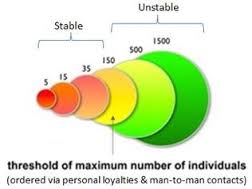
dunbarHumans are social animals.  Our ability to survive and thrive has been based on our interconnections.  Although technology has created the ability to “connect” with anyone around the world, our greatest and most meaningful connections are with those around us.  The people that we interact with regularly make up our “tribe”.  Despite the infinite number of possible connections, Dunbar’s number is a suggested limit to the amount of people with whom one can maintain social relationships.   Although it is merely a guideline, it makes for an interesting starting place when discussing organizations such as soccer clubs.

Soccer clubs in the United States have become a pervasive part of the landscape of the sport.  While many of these clubs are entities that improve the sport and the lives of its members, there is definitely room for improvement in the establishment and organization of a larger number clubs.  In essence, the successful club needs to find a balance in a two front battle of: where clubs come from and where the particular club is going.

Where Clubs Come From

Clubs start with people.  During my last trip to England, I went to an academy match at Dagenham & Redbridge.  It’s a small lower league club on the outskirts of London.  I was early for the match, so I went into the club house to stay warm and grab a beer.  It was obvious to the twenty or so people that were there that I was an outsider.  Perhaps I was pegged as an American because of my clothes but even without that, it was pretty obvious that all of these people knew each other.  That is the whole point!  Clubs are communities.  Although soccer is now the focal point, the social aspect is the starting point.  People’s need to be together is where clubs truly start.  Soccer clubs are just a subset of something that people have been doing for centuries for a variety of reasons.  Since being together is so integral, it should not be forgotten.

Club Direction

The second consideration is the club purpose or direction.  At some point (hopefully at the beginning), a club needs to define a purpose.  This is probably the biggest issue that most clubs have.  They are unsure of why they exist and therefore struggle to do more than be the administrative support for individual teams.  While this may seem like a completely acceptable arrangement, it is a neutered version of what the organization can be.  Clubs can improve young talent, be a force for good in the community, build confidence in young people or it can do all of the above and more.  Often this is done by default rather than design.  The results are felt by a small number of the members rather than the culture perpetuating them.  The vision and the actions of the club need to be in alignment with one another.  Being the club that helps develop the self-esteem of young people, is a fine vision for a club.  However this vision is inconsistent with having twice-annual tryouts.  Be who you are.

Once the vision is in place, Dunbar’s number can be applied in a variety of ways.  Although it may seem that Dunbar’s number lends itself toward the organization of smaller clubs, it can actually be applied to any size club but needs to be done with intention.

The Community Club – A local club that encompasses both a recreation and travel program can be an extremely effective environment.  With the shared surroundings, schooling and history, these types of clubs represent why Dunbar’s number was developed in the first place.

The Travel Teachers – A small club with a team at each age U9-18 hits Dunbar’s number almost perfectly.  While this may seem to max out the number, it truly depends on the structure and direction of the club.  Truly the U18 players do not need to relate directly with the U9s.  However if that is part of the culture that is being built, the older players can be mentors to the younger ones.  This type of scenario can have a virtuous cycle of development over the years.

The Talent Incubator – At some slightly larger clubs, it may be beneficial to have players of the same age group practicing and interacting regularly.  Rather than players being sectioned off as teams, an entire age group becomes a tribe unto itself.  The players see the competition at their own level regularly.

The Regional Behemoth –  A larger club can effectively apply Dunbar’s number by sectioning itself into smaller subsets.  All of these subsets need to understand the overall vision of the club.  This type of club is usually the most difficult to manage because of the sheer numbers.  However effective management can be achieved by each subset having a direct link to the central structure.  The name or the club’s reputation usually bring the players in but often teams tend to splinter off when they feel separated from the organization.  People are more loyal to friends and teammates than they are to logos and reputations.  So the club must always try to maintain its humanity regardless of size.

These examples are just generalizations of possible application.  However these short descriptions represent what many clubs have failed to do which is create a structure based on a thought process.   Dunbar’s number is a guideline that helps to avoid the pitfalls of over expansion without planning.  Humans are social creatures by nature.  Realizing and embracing that fact from the beginning gives anyone looking to build an organization a much greater possibility for success, whatever that word means for your organization.

Stand up and be counted!

Pete

Blogpost, self-reliance

The Chewing Tobacco Solution

tobaccoMy cousin who is fifteen years older than me used to go on vacations with my family each summer.  At the time, I was a teenager and he was in his early thirties with a very successful career in retail.  Despite my seemingly inferior station in life, I was able to change his life for the positive with little more than a few words.  I’m hoping that the process can give some hints about making big changes in your life.

It was completely unintentional but it sticks out in my memory as if it were scripted out.  My cousin was and is pretty fanatical about health and fitness.  He would run everyday, do push-ups and sit-ups in order to maintain his chiseled physique.  Despite this relentless pursuit of fitness, he had a habit that seemed out of place to me.  He used chewing tobacco daily.  It wasn’t anything that particularly bothered me.  I had friends who used it.  The thing that felt out of place was that it seemed contrary to all that he valued.  So as we were driving home from North Carolina and he got his spit bottle ready for his next lip full of tobacco, I made the simple statement.  “It seems odd to me that you do that.  You are so healthy in all other parts of your life but you do something that you know is horrible for you.  I just don’t understand.”  That was all that it took.  He didn’t tell me until much later that he had quit using tobacco and that was the reason.

Many of our decisions break down to the story that we tell ourselves about ourselves.  It could be true or it could be bullshit.  The main thing is that the story is effective at moving life forward in a positive manner.  The reason why my simple statement was able to change my cousin so quickly was that it showed an inconsistency in his story about himself.  In that situation, I knew his story about himself and showed him how the tobacco didn’t fit.  People want to stay consistent with the image that they have of themselves.  That’s the entire reason why the term “midlife crisis” exists.  Men (usually) make poor decisions in order to maintain an image that they have of themselves as young, cool, etc.

The first step to changing a behavior in yourself or someone else is to know the person’s story.  What is an identity that they want to uphold at all costs?  Is their family the center of their world?  Do they think of themselves as an athlete?  Do they think of themselves as successful?  Once you know the story, take that thing that needs changing and flip it against their story about themselves.  I keep saying they but I really want you to do this to yourself.  So if your family is extremely important but you are obese, then you actually don’t care about them very much.  If you truly cared, you’d do your best to guarantee that you’ll be around for them.  The combinations of stories and behaviors is infinite.

The key is to find the one that works.  Results are what we are after, not an excuse to feel bad about one’s self.  Your mind can play tricks on you.  It is time for you to play tricks on it to help you get where you want to go.  The possibilities of your tomorrow need to be forged in the thoughts that you have today.

Tell yourself a better story about you!

Pete

Blogpost, self-reliance

Shipwrecked

OarsMy son and I have taken a few trips down the Musconetcong  River in an inflated two man boat.  The first two trips were successes.  On the third trip, I completely misjudged the river conditions.  We ended up popping the boat, walking much of the trip (in and out of the water) and my cellphone ended up getting waterlogged.  The trip was not ideal by any stretch of the imagination.  As usual we were dropped off at the river several miles from our house and then left to make our way home.  The low water levels did not become a true problem until we were about a half hour into the trip.  At that point, it is too late to turn back.  Luke and I had anticipated a few bumps along the way but we got a full on shipwreck and I’m so glad that we did.

Neither of us enjoyed the trek that we made down the river.  Half of the time we were in the boat, half we were out and eventually when it popped we had to walk the river without an exit to the road for a while.  Regardless of our poor circumstances, we kept chatting and dealing with small problems as they arose.  It was not the trip that we wanted but that didn’t mean that we had to hate it.  This was not taking lemons and making lemonade.  This was slogging and knowing it was slogging but moving forward anyway and not lamenting it.  It was something that had to be dealt with.

All too often life hands us poor circumstances.  In the natural world, lamenting your circumstances gets you nothing.  It is only in our overly cushy society that complaints do much to improve a situation.  Generally speaking, the world is not interested in your comfort, preferences or desires.  It gives you circumstances and you can choose to whine or choose to move forward.  A shipwreck is not particularly a death sentence or even a negative occurrence, unless you decide that it is.

Bon voyage!

Pete

Blogpost, self-reliance

Don’t Marry Your F#@% Buddy

FBuddyIt’s so obvious on one level.  A spouse is someone that you are supposed to spend most of your days and the rest of your life with.  So choosing a person that offers a one dimensional relationship is absolutely ludicrous.  It would make for a very long and difficult daily road because all of the other areas of your life would suffer.  The sex would be great but what do you do with the other 23 hours 59 minutes of the day?  Most likely that extra time would be spent trying to makeshift a life with someone who should have been a guilty pleasure but has become a daily burden.

This is a description of a very extreme situation that is probably not realistic to most people.  Almost no one marries their “f#@% buddy” because it makes no sense and few of us would make that foolish decision.  The reason is that it is such a big decision that it would usually get sorted out before the cutting of the cake.  Signs would be so obvious that either self-examination or friends would intervene.  But what happens with the small things?  Marriage is a big decision or at least is should be.  The small decisions might be the ones that sneak through almost undetected.

Each of us has them, the guilty pleasures that we love probably more than we should.  Ice cream, chocolate, Youtube,  beer, physical affection and so many more are pleasureful things in their correct amounts.  However when we “marry” them and make them a central part of our existence, they wield an unbalancing power.  Just like the fictitious marriage that seemed so obviously out of place, relationships with items and experiences can create a burden in the other areas of your life.  It’s easier to dismiss because it is not a person that you need to take home with you.  It’s a thing, a moment in time that you deserve and the consequences will be dealt with later.

So now it is up to you!  Are you married to one of your “f#@% buddies”?  Then choose!  You don’t need to break it off completely (unless you want to).  The key is to put this relationship into its proper context.  See it as it really is and not let it take over.  Then you are available to marry the things and experiences that you really want!

Have a great weekend!

Pete

Blogpost, self-reliance

Fight or Flight?

LizardWe are in essence prehistoric animals.  The core components of our brains are basically the same as that of a lizard.  Although we have the capacity for higher level thinking and reasoning, when faced with certain threats, the reasoning part of our brain gets short-circuited or overridden by our reptilian brain.  The response of fight or flight is an instinct.  In the modern world, we do our best to act as if we are civilized and rational.  The problem is that when push comes to shove, we literally forget logic and go to our most primal reaction.

The only way to avoid this devolution is to train against it.  This is possible because we are basically never in true peril.  Letting our brains go on “fight or flight auto-pilot” is useful when under attack by an animal but how often are we in a life and death situation?  Most likely the “peril” is only perceived.  Only a metaphorical death is on the line.  However we make it so real that we react with our lower self.  The answer is action, not reaction.  Reaction is usually the ugly head of the lizard.

The key to keeping the lizard at bay is to be prepared and take total responsibility.  Most of our fight or flight responses are due to our interactions with other lizards.  If you know in advance that you are going to be dealing with someone’s lizard brain, it’s easier to keep yours from reacting in kind.  Also take total responsibility FOR YOURSELF.  Break down that word, RESPONSE – ABILITY.  Be completely able to respond to the situation, the actual situation and not some overblown version that was created mainly in your head.  You most likely will not die from this situation.  So why put yourself into the life or death mode?  A better life is a result of better actions.  Be better than the lizard today!

This concept came up during my recent interview with Laura G. on her radio show “Thoughts, Tools and Tough Love”.  Click here to listen.

Blogpost, SoccerLifeBalance

When Heroes Endure

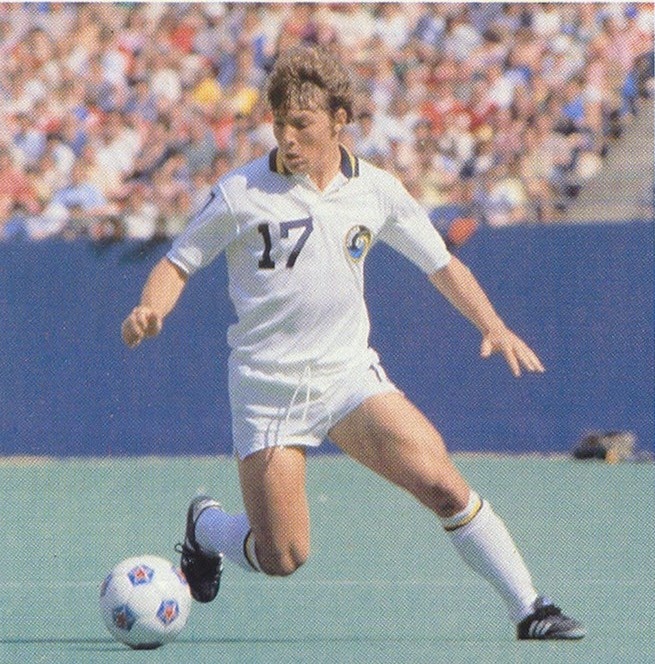
Ricky Davis 79Time brings everything into perspective.  It is only with time that we can look back and see the moments that have shaped us.  Deciphering which moments will be truly important as they happen can be almost impossible.  It is amazing to think that a chance meeting from my childhood started me down a path that I follow to this day.  Even more surprising is that another encounter with that same person gave me more inspiration in my present day life.

Ricky Davis was a member of the New York Cosmos in the late 1970’s and early 1980’s.  He was a young American player on a team of international superstars.  It was during this time that he was invited to attend a block party by a fan, Tony Gonsalvez.  I was a seven year old kid at the party who knew nothing about soccer.  However when Ricky started kicking the ball around with a group of kids, I was happy to jump in.  That is my first memory of kicking a soccer ball, it changed my life and I’ve never forgotten it.

At the National Soccer Coaches Association of America’s annual Convention, I got the chance to sit down with Rick and talk about some of his experiences and beliefs about soccer both then and now.

Q: Did you view yourself as a trailblazer or pioneer for soccer in America while playing for the Cosmos?

We didn’t look at ourselves as trailblazers or pioneers.  We felt extremely fortunate to play with an awesome team and for an awesome organization.  Reflecting back now it’s easier to see how things have developed but at the time, we just felt fortunate.  It’s awesome to look back and say “I played a part in that” but at the time it was hard not to think how lucky we were to be playing for that team.

Q: What do you think about your legacy?  How does it feel to have players like myself say that you were the reason we started playing?

It feels great!  It’s part of the evolution of the game in this country.  I came into the situation with possibly a naive perspective because I believed that professional athletes were the closest thing there was to perfect human beings.  They didn’t drink or smoke.  Doing things to help keep themselves fit were all part of a value system that I brought with me when I came to the team.  In many ways I learned that wasn’t the case but did that mean that I needed to change?  I feel that I’ve got this debt to the game.  I was fortunate to have all of these experiences and memories and now I’m just trying to pay it back.  Much of what I did was to invest in the game and the community because I wanted people to love the game that I loved.  

Q: What were some of your attributes and life experiences that allowed you to be successful at that time?

It started because I had a good family.  My parents were actively involved.  Much of my values came from my parents.  My dad used to joke that everybody should work a solid half day (12 hours).  When there was extra stuff to be done, the clinics, public appearances and other things were part of that twelve hours.  Whether I needed to work on my own or do those other things, I needed to give 100%.  I was raised with a strong work ethic.  Also had great influencers within the team, Pele, Franz Beckenbauer, Johan Neeskens, I couldn’t be them but I could learn from them.  My belief was that I could learn from anybody.  After the games, I would go into the parking lot and talked to fans.  They would give suggestions and there were gems there for me to take.  If nothing else, I heard things that were important to them.  These were things that I took from my parents and tried to pass onto my own kids.  It’s not what you want to get out of it, it’s what you put into it and you’ll get back.

Q: What do you believe is special about this game?

It’s a game for everybody.  Almost anyone can get involved unlike many of the traditional American sports.  The reality is that a kid can be a part of something regardless of their size or ability and they’re equally part of the team.  You can be small like Messi or Maradona.  You can be big like Ibrahimovic.  Soccer is truly the game of the people.

Q: Where are we going as a soccer nation? 

As a nation we’re going in a great direction.  When I see soccer touching our little part of Kansas, it makes me believe that soccer is taking strides forward.  Soccer is becoming part of America’s fiber.  Was the NASL a bad thing?  No, it was a part of our evolution.  I see a national team that is way more competitive than my generation was.  The public is much more accepting of the sport.  The Cosmos was unique.  Even though many of our players were in the twilight of their careers, we were able to play with almost any team in the world.  Set the Cosmos aside though.  If you look at the teams now, they are drawing good sized crowds. Soccer specific stadiums are huge.  The people investing in soccer in this country, it obvious that it’s a long term commitment to the sport.  

Q: What is your involvement in Futpong?

The idea is not new.  We played similar games with the Cosmos.  If you thought the games on the field were intense, you should have seen these games.  The games used to be very improvised but we’ve now standardized it with a small net and a small ball.  Futpong is designed to develop their touch and fine motor skills.  Our hope is that this will help develop the touch and control.  We want it to be fun and stimulating.
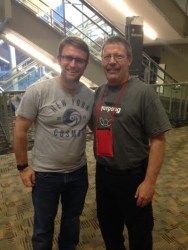
Rick Davis 2016It was a great treat for me to be able to sit down with Rick.  The nostalgia factor would have been enough for me  in this interview but our discussion made me respect the man behind the memory even more.  His commitment to family, hard-work and openness to learning from anyone were all examples of why my respect for him has grown.  Anyone who has read my material long enough knows that I don’t truly believe in heroes because we should strive to be our own hero.  However I do believe in role models.  Even though I didn’t know it as a 7 year old, I chose a very good role model and learned a few things from him as a 40 year old.  The game does not make us who we are but rather draws out that which is already inside of us.  I’m glad that the game brought Rick and I together twice.

Thanks Rick!

Pete

Blogpost, self-reliance, SoccerLifeBalance

Soccer for the 21st Century

The 20th Century of the United States was largely dominated by an industrial economy.  The US rode the wave of the industrial revolution into prominence on the world stage.  Factories flourished thanks to interchangeable parts and largely interchangeable people.  Most workers in the 20th Century were able to earn a substantial living by doing simple repetitive tasks under the orders of their bosses.

In this system, it is no wonder that the sport of the century was Football.  In so many ways, football was representative of the American way.  It was progressive.  Moving forward was success and moving backward was failure.  It mirrored our historical land acquisition with its own “land acquisition”.  The decisions were made by a few bosses and executed by largely  interchangeable people.  The sport was the perfect corollary for the industrial age and both served the country well in their time.

Now that the industrial age has passed and we have moved into what many are calling the “Connection Economy”.  The people who create value in the market place are not interchangeable cogs in a vast machinery.  Cogs can be replaced, automated or outsourced to other countries.  True value in the modern economy is created by an individual whose contributions are irreplaceable and unique.

This change begs for a different representation in sport.  The football model of “run the play” holds little value when the rules of the game change so quickly.  Soccer’s flexibility and subjectivity require that players deal with complex problems and must make individual decisions for the betterment of the collective.  Since each player is a decision maker, principles rather than directives are the dictating forces.  No one person is in control.  Therefore players must learn to control themselves and direct themselves in an uncertain environment.

The beautiful game will become “America’s Game”.  It is just a matter of time.

Pete