 For the past six months or so, I’ve been learning Polish using a program called Duolingo. It is a completely free online language learning tool. I started using it to prove the point to my students that you can learn a foreign language by using such a tool. When summer hit, I took a Polish hiatus but now I’m back on the train. The funny thing is that I’m not sure that I’ll ever get to Poland. It is the homeland of my ancestors and I love to travel but it is not a huge priority. So then why bother to learn the language? There is no foreseeable return on my daily investment of time and energy into this language.
Return on investment is an almost pervasive calculation in the modern world. Kids and adults alike seem to be in a never-ending calculation of whether or not things are “worth their time or effort”. This is not particularly the troubling thing. Time is a nonrenewable resource. So being conscious of how you are spending it just makes sense. Energy is renewable but often feels like it is linked to the time. As if the addition of energy to invested time multiplies it and can magnify any possible waste. “I’m only applying if I know I’ll get the job.” “I’m not going out for the team unless I’m on varsity.” “I’m not going to ask her out, she might say ‘no’.”
The problem with this almost ruthless avoidance of wasted energy/time is that very few limits get pushed. Possibility is viewed as a negative rather than a positive. Life tends to shrink into a smaller and safer box that confines and disillusions us. Investing in only sure things expends nothing extra. It is a transaction of time and effort for a result. In this type of mindset, there is no room to give true gifts. People become hoarders because giving of themselves is too risky and scary. In the end giving of one’s self is the best way to come to know yourself better.
The sure thing may be comforting but it is not progressive. Putting ourselves outside of our comfort zone or spending ourselves in an uncertain endeavor are the places where we become a new version of ourselves. Much like a software update, we have the possibility of becoming more but it requires some risk to the old version. Perhaps I’m throwing away ten minutes per day by learning Polish. Or maybe risking that small amount of time each day will take me somewhere that I never would have imagined. In my eyes, I win either way because of who I’ve become; a person willing to move forward. Where you are is most likely not where you want to be forever. The opportunity is there for you to move forward but you have to risk the time and energy of the step. It’s time to step up!
Pete

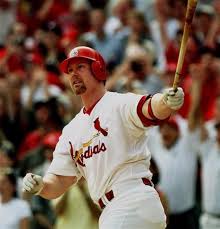 In 1998, Mark McGwire hit more home-runs than any other player in MLB history. I vividly remember watching the games to see if he would break Hank Aaron’s record and I’m not even a baseball fan. At the time, I remember becoming personally moved by the chase for the home-run record. It changed the way that I thought about several things in my life and it had nothing to do with home-runs but rather strikeouts. McGwire lead the league in home-runs that year but he was also near the top of the leader board for strikeouts. He struck out 2.2 times more than he hit home-runs. In theory, the strikeouts are failure but in reality they are three more pieces of data.


